In August 2022 it will be five years since the start of one of the world’s most severe humanitarian crises, yet the political and security dynamics surrounding Rohingya refugees in Bangladesh remain unstable. Persecution and targeted attacks against this minority community by Myanmar’s military led to the forced displacement of over 730,000 refugees across the border into Bangladesh in 2017. Five years on, their lives continue to be marked by struggle.
Bangladesh’s own history of war may have influenced its government’s openness to refugees, but growing uncertainty in a post-Covid world, anti-Rohingya sentiments amongst the population, security concerns, and pressure on resources are cited as reasons for a recent rise in restrictions on residents of the 34 refugee camps along the border. These restrictions relate to refugees’ uninterrupted access to education, employment, movement, and civic participation in their host country. Underdevelopment, poverty, crime, and trafficking in people and drugs affect both the Rohingya and the host communities adjacent to the camps.
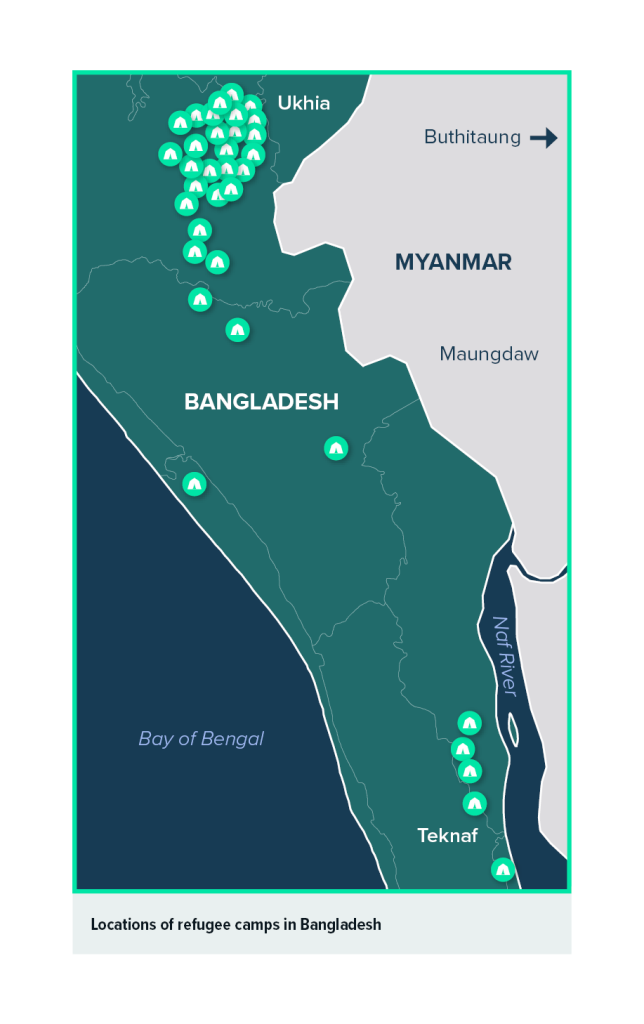
Despite vocal demands by Rohingya to be able to return to their home villages, organised repatriation attempts have been hindered by lack of political will in Myanmar. Today, global humanitarian aid is on the decline as the international community contends with the need to address competing crises. Refugees and local communities are angered by the limited efforts of global powers to compel Myanmar to accelerate Rohingya repatriation. Increased frustration amongst Bangladeshi authorities has translated into harsher policies and limited opportunities for the refugees. Amid pressure to uphold refugee rights, and the need to maintain safety and adequate infrastructure within the camps despite a persistent funding shortage, actors involved in the response face increasing challenges around sustainable solutions for Rohingya populations.
The Asia Foundation’s partner in Bangladesh, Centre for Peace and Justice, Brac University, (CPJ) has worked to address emerging concerns amongst Rohingya and host communities, and analyse social differences and political dynamics through various research initiatives that aim to understand and elevate voices on the ground. This article summarises viewpoints of Rohingya refugees on their current predicament and outlook, compiled by CPJ researchers since 2018.
Camp governance and decision-making mechanisms have been criticised by human rights groups for being unclear, restrictive and ad-hoc. With an ever-shifting regulatory dynamic, limited direct access to policymakers, and a national refugee policy vacuum that allows lower-level officials to apply rules at their own discretion, the governance environment in Cox’s Bazar remains opaque, complex and exclusive of community voices. Humanitarian agencies focus on maintaining permission to work in the camps and are hesitant to intervene and probe officials about policies. It is unclear to communities how decisions about refugee policy are made within government and by whom, resulting in a power gap and lack of accountability toward stakeholders.
Who is making decisions and why are they unknown to our community?
a Rohingya refugee in Bangladesh
Livelihood possibilities in the camps are extremely limited. Rohingya are restricted from moving from one camp to another and have no right to formal employment or access to markets. Even the need to travel for medical attention requires the permission of camp authorities. Hundreds of makeshift shops have been destroyed by authorities in recent months, limiting refugees’ access to basic necessities not provided as aid, including many cooking ingredients as well as clothing.
Perceptions of the Rohingya amongst host communities are generally negative even though, according to CPJ’s research, only a small percentage of host community residents have personally interacted with a refugee. Local people fear the assimilation of refugees and the increased pressure on already-stretched resources. Negative impacts on wage rates and over-saturation of the labour market have been contentious issues.
Education gaps among Rohingya children and adolescents remain unresolved. Approximately 400,000 school-aged refugees are not enrolled in formal schooling, and although a pilot formal education programme was recently launched when schools reopened post-Covid, it serves only a small percentage of learners and many will likely never return to their studies. Moreover, private learning centres organised by the Rohingya have been restricted by authorities, eliminating educational access for thousands more children.
Global attention has been fleeting. The spotlight that brought attention to the Rohingya crisis after the 2017 exodus has shifted elsewhere, and Rohingya feel that they are isolated from the international community. Bangladesh continues to be praised by the international community for hosting persecuted Rohingya and undoubtedly saving thousands of lives, but refugees are frustrated with the lack of public discussion around their current situation. Many claim that living conditions within the camps have deteriorated leading to desperate attempts by refugees to escape, akin to their pre-exodus state of vulnerability in Myanmar. High-profile international delegations have resumed visiting the camps, but few visits have resulted in tangible action toward the necessary changes.
Sustainable, long-term solutions for displaced Rohingya will require a comprehensive refugee policy in Bangladesh, built on accountability to affected populations and effective coordination amongst national and international actors. Such a policy will need to address concurrent needs for good governance, refugee rights and participation, humanitarian service provision, and security-related factors, grounded in robust data reflecting the evolving needs and perspectives of refugee and host populations. Political economic analysis can be used to assess the current policy environment, highlighting gaps that need to be addressed, an understanding of how decisions are made and enforced, and identifying areas for innovative approaches to refugee governance. For example, Rohingya participation in labour markets could be approached in a way that benefits refugees and impoverished Bangladeshis alike. Such a coordinated, inclusive approach may yet yield opportunities for improvement.
The past two decades have seen a slew of programmatic efforts aimed at countering an individual’s susceptibility to violent extremism. These initiatives have delivered uneven results. This blog post examines the role of mental health and conflict-related trauma in driving individuals towards embracing violent extremism. By showing the high propensity of pre-existing trauma and associated mental health problems among violent actors in extremist movements, it argues that successful interventions cannot afford to overlook this component of the “radicalisation” puzzle.
Studies that have examined prison[1] and community-based populations[2] have shown that individuals who use violence are significantly more likely to be survivors of violence and trauma than their non-violent counterparts.[3] Whilst this is true for different types of violence – for example, against an intimate partner, children, strangers – it is also true for those who pursue violence for ideological or political goals. The documented link between trauma and the propensity to engage in violence is particularly sobering when considering the prevalence of trauma among conflict-affected populations: it is thought that up to 65% of civilians affected by civil war or conflict suffer some form of recurrent trauma.[4] This can include violence and/or rape, but also forced displacement, homelessness, starvation and slavery.
Programming to support violence and conflict prevention must incorporate a better understanding of the types of trauma experienced by conflict actors and the communities in which they operate. Two things are particularly important here: (i) types of trauma(s); and (ii) how trauma can be transmitted from one generation to the next. Violence driven by a desire for revenge is often borne of complex traumas that involve incidents such as family members being killed or kidnapped and/or suffering prolonged periods of imprisonment or torture.[5] Traumatic stress can also manifest in individuals who have been exposed to some form of abuse outside of conflict dynamics – for example, being abused by a parent. In this scenario, parents who are traumatised by conflict can, in turn, transmit their experiences by traumatising their children who are then more susceptible to violence themselves when entering adolescence or adulthood.[6] Trauma-related mental health problems, such as post-traumatic stress disorder, depression, or anxiety, are important because if they are untreated, not only do they associate with violence, but they can also leave an individual vulnerable to joining up with a violent extremist group.[7]
Appreciating these interlocking dynamics is important when considering how to break cyclical periods of violence and peace in recurrent conflicts. Put another way, how might a better appreciation of the interaction between trauma and mental health inform our understanding of how and why an individual might choose either a violent or peaceful action? Our working hypothesis on the KCL team for The Cross-Border Conflict Evidence, Policy and Trends (XCEPT) project – and it’s one that we’ll be empirically testing as the research progresses – is that trauma is an often overlooked but extremely important part of an individual’s ‘radicalisation’ journey. In brief, XCEPT is a multi-year, interdisciplinary project with funding from UK Aid, that examines factors that shape violent and peaceful behaviour across different conflict-affected regions, such as Iraq, Syria, and South Sudan, to inform policy and programming efforts to prevent violent extremism.
The good news for policymakers is that trauma-related mental health interventions related to traumatic events need not be created de novo. There are already several effective interventions that are scalable, which means they can be offered to large numbers relatively cheaply. Bodies such as the World Health Organisation have databases of scalable interventions which are ready to go.[8] These are culturally adaptable and can be deployed through easily trained partners on the ground.
Consider one particularly encouraging intervention for children and teenagers, known as Teaching Recovery Techniques. This helps individuals learn socio-emotional skills to cope with difficulties following traumatic experiences of war,[9] whilst also teaching them how to manage intrusive thoughts and feelings (bad memories, nightmares and flashbacks), arousal (difficulties relaxing, concentrating and sleeping) and avoidance (fears, difficulties in facing up to reminders of a disaster).
Although this is just one example of many, it shows the types of interventions already available which are easily scalable and which can be delivered over a relatively short period (in this case, just five weeks). It is also important to consider that this intervention can be modulated to address non-conflict related traumas (for example, childhood maltreatment).
Trauma is cumulative. The more individuals experience it, the more likely they are to have greater mental health problems. That, in turn, increases the risk of them turning to violence. Some estimates suggest that up to 50% of people who join violent extremist groups demonstrate some form of childhood maltreatment: neglect, or physical or sexual abuse.[10] This reveals the importance of adopting a holistic intervention approach around trauma and mental health to effectively manage an individual’s risk of choosing violent outcomes in any given situation,[11] and to include such approaches in interventions to promote peace and prevent resurgent conflict violence.
[1] Wolff N, Caravaca Sánchez F. Associations Among Psychological Distress, Adverse Childhood Experiences, Social Support, and Resilience in Incarcerate Men. Criminal Justice and Behavior. 2019;46(11):1630-1649.
[2] Taylor LK, McKeown S. Does violence beget violence? The role of family ethnic socialization and intergroup bias among youth in a setting of protracted intergroup conflict. International Journal of Behavioral Development. 2019;43(5):403-408.
[3] Widom CS. The cycle of violence. Science. 1989;16(244):160-166.
[4] Allwood MA, Bell-Dolan D, Husain SA. Children’s trauma and adjustment reactions to violent and nonviolent war experiences. Journal of the American Academy of Child & Adolescent Psychiatry. 2002;41(4):450-457.
[5] Klasen F, Gehrke J, Metzner F, Blotevogel M, Okello J. Complex Trauma Symptoms in Former Ugandan Child Soldiers. Journal of Aggression, Maltreatment & Trauma. 2013;22(7):698-713; de Jong JTVM, Komproe IH, Van Ommeren M, et al. Lifetime Events and Posttraumatic Stress Disorder in 4 Postconflict Settings. JAMA. 2001;286(5):555-562.
[6] Galovski T, Lyons JA. Psychological sequelae of combat violence: A review of the impact of PTSD on the veteran’s family and possible interventions. Aggression and violent behavior. 2004;9(5):477-501; Dekel R, Goldblatt H. Is there intergenerational transmission of trauma? The case of combat veterans’ children. American Journal of Orthopsychiatry. 2008;78(3):281-289.
[7] Simi P, Bubolz B, McNeel H, Sporer K, Windisch S. Trauma as a precursor to violent extremism: How non-ideological factors can influence joining an extremist group. START Newsletter. 2015.
[8] Organization WH. Scalable psychological interventions for people in communities affected by adversity: a new area of mental health and psychosocial work at WHO. 2017.
[9] Ali NS, Al-Joudi TW, Snell T. Teaching recovery techniques to adolescents exposed to multiple trauma following war and ongoing violence in Baghdad. The Editorial Assistants–Jordan. 2019;30(1):25-33; Sarkadi A, Warner G, Salari R, et al. Evaluation of the Teaching Recovery Techniques community-based intervention for unaccompanied refugee youth experiencing post-traumatic stress symptoms (Swedish UnaccomPanied yOuth Refugee Trial; SUPpORT): study protocol for a randomised controlled trial. Trials. 2020;21(1):63; Barron IG, Abdallah G, Smith P. Randomized Control Trial of a CBT Trauma Recovery Program in Palestinian Schools. Journal of Loss and Trauma. 2013;18(4):306-321.
[10] Lewis J, Marsden S. Trauma adversity and violent extremism. Contemporary Research. 2021.
[11] Lewis J, Marsden S. Countering Violent Extremism Interventions: Contemporary Research. 2021.
Social media has become an indispensable aspect of everyday life. Platforms such as Twitter, Facebook, Telegram, Tumblr, Kik and Ask.fm have also become hosts of a virtual minefield of extremist and violent content and political misinformation. Countless academic articles and reports have drawn upon user-generated content alongside official group publications circulated on social media platforms as primary data for research. Such media includes hate-filled speeches by extremist ideologues, logistical communications for group recruitment and photographic and audio-visual evidence of violence and abuses committed by official members and inspired adherents. This has enabled greater understanding of the recruitment strategies, propagandistic narratives and influencers of extremist groups, and has opened a field of work focused on counter-narratives to prevent and deter individuals from succumbing to the influence of online extremists.
This all sounds very positive, but what are the costs and risks of this research? Here, I argue that the welfare of the researcher frequently slips through the net of the ethical principle to ‘do no harm’.
For researchers affiliated with an academic institution, ethical considerations form a necessary part of the planning process for any study involving human participants or human data. In order to receive approval from the independent Institutional Review Board (IRB), a proposal in either the social or medical sciences must demonstrate evidence of planned measures to mitigate harm and safeguard research subjects, particularly those considered especially ‘vulnerable’. However, an in-depth study carried out in the United States in 2017 of national and international research ethics policies revealed a consistent lack of explicit definition of what ‘vulnerability’ in fact was.
The primary concern and mandate of the IRB is to safeguard the researched rather than the researcher. In cases of research conducted in unstable or insecure contexts, approval may be granted upon condition of completion of a risk assessment form, requiring researchers to demonstrate protection against potential physical harm to themselves, their colleagues and their equipment. However, there is usually little or no mention of safeguards for psychological harm to the researcher. Furthermore, if the research is solely based on documents such as social media posts or audio-video recordings already in the public domain, generally no ethical approval is needed at all.
The vulnerability of researchers therefore largely falls through the cracks of the ethical review process. Moreover, in the context of gruelling publication pressures and the emphasis on terrorism as a fluid and fast-paced phenomenon, self-care is frequently overlooked or seen as a sign of one’s inability to ‘handle’ the demands of the field. Seamus Hughes, Deputy Director of the Program on Extremism at George Washington University, summed up the issue when he explained that the mental toll of research is ‘the type of thing that nobody really talks about’. Fortunately, the tide is changing.
Recently, attention has turned to the unseen, psychological toll of viewing extremist or violent content, particularly in light of brutal videos of amputations, killings and torture conducted by Islamic State (IS) and circulated internationally on social media platforms. Cottee and Cunliffe’s study of audience responses to watching official English-language IS propaganda videos is widely read and outlines the authors’ steps to mitigate harm to their participants, including removing scenes of explicit ‘ultraviolence’, in which the victim is killed. However, Carol Winkler, Professor of Communication Studies at Georgia State University, has directly challenged this approach. She suggests that simply omitting the scene of ‘ultraviolence’ does not remove the ‘promised violence’ that elicits the audience’s emotional reaction. This, then, prompts consideration of the psychological risks to researchers whose work does not include or explicitly focus on the ‘ultraviolent’ visual climax of extremist imagery.
My own empirical research has thus far adopted a different approach to studying the policies and activities of IS. While documentary evidence provides a baseline for comparison, my focus has been the first-hand testimonies of (female) civilians who lived under the group’s rule. By nature of engaging with survivors of conflict, my research required high-risk ethical approval. The scope of experiences of life under terrorist rule are broad. Some stories of defiance are uplifting, empowering and inspiring. Other narratives of captivity, genocide and sexual and gender-based violence are harrowing.
Extensive measures were put in place to protect my research subjects from the negative effects of narrating and reliving traumatic events. However, I participated in that process with each of them through almost seventy hours of one-on-one interviews. Just as violent imagery takes an emotional toll on an archival researcher, so too does the experience of listening to detailed recollections of traumatic experiences. This is known as ‘vicarious trauma’, a self-transformation in the researcher as a result of empathic engagement with reports and stories from trauma survivors. It is important to note that vicarious trauma extends beyond the allotted time of interview. Long-term traumatisation resulting from research participation is acknowledged in the ethical approval process for the interviewee, but again is often overlooked for the interviewer. For weeks on end, I worked on transcription, transporting myself back to each interview. Where I had gained consent for audio recordings, I could also replay the women’s voices, rewinding and repeating second by second in my headphones. Despite a busy office environment, such a task can feel isolating and emotionally draining.
The issue of vicarious trauma is well researched within the area of psychology, with a particular focus on the experiences of therapists and counsellors. However, research by Coles et al. reveals that academic researchers and analysts are at higher risk of vicarious trauma because we (largely) do not adopt an assistance role. Indeed, in a recent study of vicarious trauma in criminological research, Moran and Asquith found that the costs of engagement may be compensated by the productive outputs and impacts on policy and practice that the research may elicit. For those who are not in a position to offer practical benefit for their research subjects, what can be done?
Jane Palmer, Professorial Lecturer in the Department of Justice, Law, and Criminology at the American University, has written a helpful blog post on recognising and dealing with vicarious trauma among researchers. Among the list of key areas of concern and consideration is ‘the researcher’s current support systems’ and she encourages the development of policies and protocols for supporting colleagues with negative impacts of their research. With public debates concerning researcher (vicarious) trauma gaining momentum among analysts of terrorism and extremist violence, this is an important juncture to bring these conversations internally within each research team and ensure preventative measures and support networks are in place.
The benefits of researching extremist violence are clear; collection of primary data can provide vital evidence of criminal activity and abuses by underground and terrorist organisations. However, this research comes at a cost. In order to sustain this work, greater measures are needed to recognise researcher vulnerability without stigma. The academic community is now starting to think about the right approach; I hope that the perspectives of early career researchers will be included. From my own experience, I would like to see greater support for and acceptance of the vulnerabilities that researchers face. This could come in the form of conference panels or support guides for scholars and analysts, as well as integration of researcher care within project design. By opening and normalising these conversations, we can progressively reduce the hidden costs of research and prioritise care for ourselves and colleagues.
What can neuroscience tell us about violent extremism? As a cognitive scientist who was part of the team that conducted the first ever set of brain scans of a radicalised population (that is, jihadist supporters), this is a question I encounter at conferences, during webinars and via social media posts. Often the question is meant rhetorically. Some social scientists have even accused me of conducting phrenology, a defunct discipline from the 19th century that is best known for looking at bumps on human skulls to make unfounded conclusions about the intellectual inferiority of certain ethnicities. My answer, if I choose to give one, is that neuroscience has much to contribute to our scientific understanding and in terms of offering practical insights. Moreover, these contributions are complimentary to rather than in competition with social and behavioural sciences.
In my experience, most social scientists and policy experts specialising in security-related issues fall on two ends of a spectrum when presented with neuroscientific data. One group is repulsed, at worst calling such research “Nazi science” or at best showing extreme scepticism about the encroachment of life sciences on what they see as something that should fall squarely within the purview of the social sciences. The other, much larger group takes the opposite position, displaying a bizarre fealty to colourful pictures of the human brain and showing a willingness to dismiss everything that they previously believed in order to usher in the findings from a “real science”.
Of course, both ends of this spectrum are overreactions. Neuroscientific research will always be subordinate to the social and behavioural sciences. It is the observations from such fields as sociology that allow neuroscientists to infer what must be going on inside the human brain given what we see at a social scale. Meanwhile, social neuroscience is largely a field that takes well-tested social psychology experiments and tries to replicate them inside things like brain scanners. Neuroscientific data is nothing more than an extra source of information that can help us to triangulate, along with social and behavioural science data, the causes of violent extremism and potentially lead to solutions as to preventing and countering them.
Rational Actors Versus Devoted Actors
So, how does neuroscience work hand in glove with the social and behavioural sciences to explain violent extremism? Much of social science research looks at war and violent conflict through the lens of rational actor models. These are models positing that people make decisions by weighing self-interested advantages and disadvantages of a particular action. From this perspective, if the pros outweigh the cons, it is then rational to go to war, join a terrorist group, start an insurrection and so on.
While rational actor models certainly explain a lot, they are insufficient at explaining the data on radicalisation, the process by which someone’s mind changes to increase their likelihood of committing political violence. Many of those who join terrorist groups leave behind comfortable, secure and materially pleasurable existences to put their lives at risk in war-torn regions of the world. They are not being rational in a self-interested way; rather, they are being group- and value-interested. We call these people devoted actors: people who are willing to make extreme, costly sacrifices (including fighting and dying) for their primary identity group and their sacred values.
The concept of sacred values has been well developed in anthropology, sociology, political science and psychology. They are a subset of moral values that do not conform to instrumental (that is, reward and punishment) decision-making. In other words, adherence to sacred values cannot be explained using rational actor models. Instead, it seems to be a fundamental element of devoted actors. My colleagues and I wanted to see how peer-group dynamics interacted with sacred values to increase or decrease a radicalised person’s willingness to fight and die. In essence, we wanted to pinpoint how peer-group dynamics can move people closer to and further from violence, to inform counter-radicalisation programmes.
Social Exclusion Pushing Extremists Towards Violence
To do this, we ran two neuro-imaging studies on jihadist supporters in Barcelona. Spain regularly ranks among Europe’s top nations for recruitment into jihadist groups and the Barcelona region is the country’s primary hotspot for radicalisation. In the first study we wanted to look at what made people at the early stages of radicalisation move towards violence. We know from decades of social and behavioural science research that social exclusion can push people towards nefarious groups, such as gangs, cults and extremist movements. In this context, we wanted to see how a sample of Moroccan diaspora men who held jihadist sympathies would react if they were excluded by non-diaspora Spaniards.
Out of a pool of 535 surveyed respondents from the Moroccan diaspora community, we recruited 38 early-stage radicals who said that they would engage in violence in defence of issues championed by jihadist groups (such as the enforcement of strict sharia law across all Muslim countries, armed jihad against the West and so on). After being screened for normal IQs and mental health disorders, the Moroccan participants played a virtual game with three ostensibly Spanish players that involved tossing a ball. For half the participants, after a few attempts, the Spanish players stopped passing the ball to the early-stage radicals and kept passing it among themselves (what the study considered a “social exclusion condition”). For the other half, the other players kept passing the ball to our participants (this was the “control condition”). All participants then entered the scanner and viewed multiple values that were either sacred or non-sacred to them, as ascertained beforehand using psychometric tools. They also evaluated their willingness to fight and die for each value.
We found behavioural and neural evidence that social exclusion moves values from the non-sacred category into the sacred one. Specifically, we found that participants who were socially excluded had areas of the brain (in particular, the left inferior frontal gyrus) that normally activates for sacred values (as evidenced in two previous studies) now activated for non-sacred values. Participants even started behaviourally stating that previously non-sacred values were now sacred. Additionally, the socially excluded participants explicitly increased their stated willingness to fight and die for their non-sacred values and made them comparable to sacred values. This is a worrying finding as this means these individuals were becoming more devoted actors. Standard rational actor persuasion techniques (such as carrots and sticks) will thus become less effective.
Social Norms Pulling Extremists Back From Violence
How do you persuade a devoted actor off the path of violence? In the previous study, we showed how social exclusion from an out-group can move in-group members who hold extremist sympathies towards violence. Next, we wanted to see how non-extremist in-group members can pull their extremist peers back from violence. To do this, we conducted a second study where we surveyed 146 Pakistani men in the Barcelona region and found 30 who explicitly supported Lashkar-e-Taiba, a jihadist group that fights on the Kashmir issue and is associated with al-Qaeda. They also explicitly supported armed jihad more broadly, saying that they would be willing to carry out an act of armed jihad and endorsing violence against the West. These participants were thus far more radicalised than those in our previous study.
As in the previous study, our participants evaluated their willingness to fight and die for various sacred and non-sacred values while in the scanner. This time, however, after they had made their evaluations, they were presented with their own responses and the average responses of Pakistanis from the broader community in Barcelona. Unbeknown to them, these responses were invented. They showed that half the time the average willingness to fight and die of the broader community was the same as that of the participants and half the time it was lower (we also wanted to include a third condition where the community responses were higher but this was not possible since the participants gave responses that were already at the extreme end of the spectrum). The Lashkar-e-Taiba supporters then left the scanner and re-evaluated their willingness to fight and die for all values.
We found that parts of the brain associated with deliberation and self-control (such as the dorsolateral prefrontal cortex) went “offline” when participants evaluated their willingness to fight and die for their sacred values. However, when they were presented with the information that their peers (other local Pakistanis) had a lower willingness to fight and die than them, this caused that same area to come back “online”. Not only that, when the supporters re-evaluated their willingness to fight and die, they reduced it to conform with their peers’ responses. Furthermore, the degree of reactivation of self-control regions of the brain predicted the extent of their conformity with their peers’ responses, indicating a link between the activation of those brain areas and the extent of their behavioural change. As such, the Lashkar-e-Taiba supporters did not change their sacred values but they did change the level of violence they were willing to engage in to defend those values once they realised it was out of step with their peer group. This provides evidence of one way – bringing the attitudes of the broader peer group to an extremist’s attention – to move a devoted actor off the path of violence.
Social, Behavioural and Brain Sciences Informing Policy Together
Both of these studies were inspired by decades of research from the social and behavioural sciences that highlight the importance of social exclusion and social norms (that is, what people suspect their peer group thinks are acceptable beliefs or behaviours). Qualitative research on violent extremism in Syria, Somalia and Nigeria has shown the importance of social exclusion as a motivating factor for why people join jihadist groups. Longitudinal survey research in the United States has shown that when marginalised Muslims face discrimination they increase their support for radical groups. Similarly, the role of social norms in reducing violent conflict has been demonstrated in post-conflict reconciliation environments. Large-scale randomised control trial studies in Rwanda and the DRC demonstrated that social norms embedded in radio soap opera programmes increased willingness for reconciliation and cooperation by changing perceptions of social norms while having no effect on personal beliefs. The neuro-imaging research simply augments these findings by offering yet another source of data.
While these studies may be the first conducted on radicalised populations, there are exciting findings emerging from adjacent fields, such as neuro-criminology. Research has shown that youth who have adverse childhood experiences grow up with an increased likelihood for delinquency and criminal behaviour, especially once they reach adolescence and early adulthood. Given the well-established links between crime and terrorism, these findings could bear important policy implications for violent extremism as well.
An obvious policy suggestion would be to try to reduce such adverse experiences in children’s lives. But what could one suggest if a child has already experienced these adversities but has not yet reached adolescence? There seems to be a window of opportunity to intervene. However, if we do not understand which psycho-neural mechanisms create the increased vulnerability to crime and extremism, any intervention will be little more than a shot in the dark. Luckily, there is some ongoing research that shows that adverse childhood experiences negatively impact sympathetic nervous system reactivity but that high-quality friendships by the age of twelve can buffer against some of these outcomes. If these results can be replicated, they will add to the research demonstrating the importance of peers, in terms of both social exclusion and social norms, in either increasing or decreasing an individual’s propensity for political violence.
This kind of research is especially prescient in such countries as Syria, Iraq and South Sudan, where there are potentially tens of thousands of children who are in this window of opportunity after having survived early childhood years amid armed conflict. Discovering and offering the right kinds of interventions for these children is a humanitarian concern, while failing to do so could lead to security issues in the future if armed groups are able to prey on unhealed trauma for recruitment purposes.
Neuroscience need not be seen as a pariah invading the domain of social and behavioural sciences, nor should it be seen as a prophet descending from on high to answer all our security-related questions. Instead, it is an ally for all empirical work that seeks to understand the factors that move people closer to or further from violence. Its findings can help to aid theoretical developments and provoke practical policy suggestions.
This blog was originally published on the International Centre for the Study of Radicalisation’s website.
The growing Captagon trade in Syria and Lebanon has been given much attention in recent months. The networks involved in this trade, such as the Fourth Division of the Syrian Arab Army and other smaller armed groups in Syria, Hezbollah in Lebanon, and networks of smugglers in both countries, help extend its reach beyond the borders of Syria and Lebanon, smuggling Captagon to Gulf countries – especially Saudi Arabia – and even to Europe. The transnational nature of this illicit activity and its link to the context of the Syrian conflict requires international policies that take into account cross-border conflict dynamics, including how people can end up involved in illicit activities to cope financially. A key component of any such policy must be an understanding of the impact of the Captagon trade specifically and drug smuggling more generally on local communities, especially those residing in border regions between Lebanon and Syria.
The Syria-Lebanon border is dominated mainly by Hezbollah on the Lebanese side and armed groups on the Syrian side, with the Fourth Division of the Syrian Arab Army being the most influential Syrian actor in the Captagon trade. The course of the Syrian conflict has seen an increase in the number of Captagon factories – some primitive, some more advanced – set up in border areas dominated by armed actors. While the factories have been mainly set up in sparsely populated areas, getting involved in the booming drug trade is often one of the few ways for local residents to generate an income.
Several areas where Captagon factories have been set up are Syrian villages and towns that have seen significant population displacement because of the conflict, such as Madaya and Zabadani, where people either fled the violence or left because they were forcibly displaced by the armed actors that came to dominate these areas, namely Hezbollah and the Syrian army. But some residents remained and others moved from elsewhere to join them. The boom in the drug trade and the lack of other employment options for residents, as well as the dominance of armed groups and warlords, presents a serious challenge to any post-conflict settlement in Syria which includes repatriating the displaced. People with an economic stake in a geographical area are not going to readily give that area up. This raises concerns regarding the potential for supporting community cohesion in Syria following any future resolution to the conflict.
In Lebanon, Hezbollah has purchased property and land in many eastern areas along the border with Syria. It has also declared a number of military zones in this region, which are inaccessible to the Lebanese authorities or to anyone not affiliated with Hezbollah. These zones help facilitate the military and non-military activities that Hezbollah engages in across the border and gives it sole security oversight that extends beyond the zones themselves and into surrounding villages where, as in Syria, drug factories recruit workers from the local communities. Even if there is a resolution to the Syrian conflict, Hezbollah’s political and military dominance in Lebanon and its engagement in Syria are likely to continue in some form – the drug trade across the border predates the start of the Syrian conflict. With the Lebanese state almost bankrupt and many border communities persistently ignored by its development policies, the appeal of the drug trade to populations in eastern Lebanon and its connection to Syria will not be easy to reverse.
As the drug trade becomes an embedded aspect of everyday life for local border communities in Lebanon and Syria, young people abandon education to enrol in this trade. Vulnerable people are particularly exploited, being forced to engage in illicit activities, pay royalties to the ruling militias or endure harassment, fraud and intimidation. This situation increases the isolation of such communities and poses a challenge to national cohesion.
The international community must consider the impact of the Captagon trade, and the drug trade more widely, on local border communities when designing a policy to counter it. Alternative sources of livelihood must be offered to those who have ended up entangled in the drug trade to cope financially – what the Chatham House team working on the XCEPT project on cross-border conflict refers to as the ‘coping economy’.
This blog was originally published on the Chatham House website.
Communities in the Central African Republic have experienced war for over a decade. Yet we rarely hear about the experiences through which they have lived. In 2020, Conciliation Resources produced a report entitled “Listening to young people associated with armed groups in north-western Central African Republic”. The report utilises a storytelling approach and offers unique insights into our understanding of the conflict. This approach has grown in popularity as a research method, as a policy tool and in everyday life. Similar efforts have now been undertaken in other conflict areas, including the Democratic Republic of Congo (DRC) and South Africa.
Here, we discuss the potential of storytelling for research that engages with conflict-affected communities and ask: Why do stories strengthen conflict research? Story-based (or narrative) research to support conflict reduction and peacebuilding centres on using first-person experiences – expressed visually, in writing and orally – to go beyond a top-down examination of conflict dynamics and explore the lived experiences of war.[1] It offers policymakers and practitioners an understanding of conflict from the eyes of those who experience it, which provides for richer research that better informs policymaking and programme design. Peacebuilding and development practitioners have long known that story-based approaches are impactful; they also know that the use of such approaches in conflict contexts requires precision, nuance and intention.
In peacebuilding, for example, storytelling interventions are used to create connections between groups and support youth development through activities such as participatory filmmaking or community theatre. In mental health and psychosocial support, virtual reality is utilised in contexts affected by violence, particularly with Syrian refugees in the Middle East. Two major factors help to explain this growth in the use of storytelling. First, the coronavirus pandemic has fostered digital storytelling as an avenue to create connections. In addition, virtual narrative methods have allowed researchers to carry out research remotely and in faraway places, overcoming travel restrictions that might otherwise limit fieldwork. Second, researchers and practitioners have increasingly recognised that the impact of peacebuilding work is enhanced when efforts are made to accommodate local realities. However, narrative approaches have been utilised more widely as a way to communicate findings rather than conducting research per se. As the increasing momentum indicates, such limited use misses out on the significant research potential that stories offer as a valid method to gather data.
At its centre, the movement towards greater focus on personal narratives and oral histories is founded on the recognition that stories contain a unique type of knowledge, particularly those from communities either living through protracted conflict or bearing witness long after violence has stopped. As narrative scholars know, history is itself a story, and the collection of multiple narratives allows for a more varied illustration of complex dynamics. An approach anchored in narrative exploration permits a richer perspective, the ability to see the world from the point of view of those researchers are trying to understand. ‘But what does narrative research entail?’
In South Sudan and the DRC, for example, the NGO Search for Common Ground used participatory methods to examine spaces of perceived safety and risk of gender-based violence for women and girls. Such studies help researchers to understand the everyday security challenges faced by women and girls and help practitioners to adapt programming to mitigate them. As such, these methods ultimately enrich research exploring the complex phenomenon that is human behaviour in war.
This involvement of local communities in research and programme evaluation is understood as a community-based participatory methodology. In peace and conflict research, it offers a flexible, participant-centred, illustrative methodology that contributes to meaning-making for those the research aims to understand. This approach argues that the direct participation of local communities in data collection and analysis strengthens peacebuilding interventions. The intersection of participatory research and narrative methods brings three distinct advantages.
First, stories provide contextual and nuanced data, bringing unique insights into conflict research, such as those encountered by disadvantaged young people or refugee women whose perspectives are otherwise often ignored. King’s College London’s Imaging Peace Project explores everyday narratives of peace in Rwanda through photography. The resulting visual narratives bring to light new understandings of peace. As such, these methodologies also complement other quantitative and qualitative research methods. By placing subjects of the research at the centre of the process, these methods engage individuals affected by conflict to tell their own stories and to focus on what they find most important. While some traditional methods are seen as extractive, narrative approaches invite us to consider participants’ agency and confront where power resides.
Second, histories challenge traditional understanding of war and favour the presentation of its complexity. In Lebanon, the NGO Fighters for Peace harnesses oral histories to explore experiences of war among ex-combatants. The stories gathered are shared with a wider audience through video, art exhibitions and theatre, bringing diverse narratives of war to the public debate. Here, oral history research allows for challenging common narratives of war. Engaging with narratives in conflict contexts permits the production of innovative research bringing novel findings on conflict and peace.
Third, a story-based method is well suited to research carried out with individuals who may have experienced trauma. Its flexibility, continued adaptation and narrative focus allow for illustrative discussion of traumatic events rather than direct questions surrounding difficult experiences. In an interview, the interviewee rather than the interviewer leads the process, focusing on certain experiences or stories more than others, avoiding the memories that may trigger them. In situations where oral recollection may be retraumatising, an interviewee can also use drawing or writing.
Even though story-based methods are valuable to, if not essential for, conflict research, they should be implemented with care. As with other methods, ethical questions surround the utilisation of story-based research methodologies, particularly when engaging with vulnerable and conflict-affected populations. A central debate revolves around whose stories we are telling and what happens to those stories. It questions who will benefit from gathered stories and what aims will be served. Initiatives to address these questions have included, for example, sharing research findings with participants and ensuring that history collection is implemented as centring on participant experiences, making research an empowering practice. Participatory approaches and mixed methods designs are also offered as meaningful avenues in this space.
In addition, it is essential to consider concerns around trauma awareness and retraumatisation. Specifically, researchers need to address the potentially harmful impacts of retelling and remembering traumatic events. Where risks have been identified, trauma-informed adaptation of the methodology is required. Although evidence is scarce, best practices – such as ensuring conversational ownership by the interviewee, intentional selection of space to conduct research (and ensure the interviewee’s safety) and offering alternative narrative tools (such as theatre, art and media) – have proven helpful. Ultimately, care and intention are paramount.
Conversely, a focus on local histories can also help researchers to address some of the ethical and methodological challenges brought by engaging with vulnerable and conflict-affected populations. Done well, narrative research allows researchers in-depth study of complex issues, a focus on representation and diversity in data collection and a better understanding of the contexts they study. An approach anchored in community participation specifically supports this endeavour. Therefore, the careful implementation that narrative methods require should not deter researchers from utilising them in both research and interventions in conflict. On the contrary, these methods open a space to address delicate questions in partnership with those the research is about. Narrative methods applied with a participatory lens should continue to enrich our understanding of conflict and provide valuable insights for policy and practice.
This article was originally published on the International Centre for the Study of Radicalisation’s website.
[1] In the humanities they are known as oral histories or storytelling while in the social sciences a narrative research framing is often preferred.
After nearly three months of backroom deal attempts and horse-trading, Iraq’s newly appointed legislators convened for their first session on 9 January 2022. Signalling their willingness to fight to the death, representatives of Muqtada al-Sadr’s winning bloc marched into the parliamentary halls, wrapped in white cloaks reminiscent of traditional Muslim burial shrouds. In an equally symbolic gesture, independent candidates and members of the reform-oriented party Imtidad (Reach/Extension) made their way to the parliament building riding Tuk Tuks, the three-wheeled icon of Iraq’s Tishreen protest movement that began in 2019.
A month before the opening session, supporters of al-Fatah, a Shiite political coalition associated with Iraq’s paramilitary Popular Mobilisation Forces (PMF) – also known in Arabic as al-hashd al-sha‘bi or simply hashd – were mourning their own brand of martyrs, who were killed protesting the very election results responsible for the current composition of the house of representatives. The mourners evoked collective memories of injustice by establishing parallels between their fallen heroes and the martyrdom of the third Shia Imam Husseyn, whose killing in the historic battle of Karbala has scarred the memory of Iraq’s Shiite believers.
What all of these groups has in common is invoking the wrongs afflicted onto their respective communities to gain leverage over the dominant narrative of Iraq’s turbulent history. This has turned the collective memory of the country’s violent past into an array of contested interpretations, with each side clinging to its own version of the truth. As long as this prevails, Iraq’s fragile democracy is bound to remain hostage constantly to resurrecting and competing victimhoods.
In particular, the lack of a consensus on the culpability of power-hungry elites for the brutal suppression of the 2019 anti-establishment protests has exacerbated the level of polarisation between different conflict-affected communities. Moreover, having captured large segments of the state architecture, these very same elites have destroyed citizens’ trust in the ability of formal institutions to deliver justice or act as impartial mediators. Therefore, the state in its current make-up faces great difficulties in generating social glue and reconciling actors on opposing sides.
Since the outburst of the civil unrest in October 2019, established Shiite parties with strong leverage over state institutions have purposefully deployed the tactic of scaremongering to delegitimise their opponents from the Tishreen movement as jawkara (“jokers”), portraying them as a foreign-sponsored threat to Iraq’s stability. As a consequence, many Tishreen supporters have grown disillusioned with the state, feeling alienated by the failure of its institutions to take a stance or at least provide protection for those on the partisan militias’ target lists. To make matters worse, the so-called defenders of the state have sought to relativise systematically the Tishreen protesters’ legitimate demands for accountability, thereby obstructing their right to a transparent investigation and effective remedy.
Acknowledging the country’s need for a fresh start, the representatives of the Tishreen movement were those who pushed the hardest against the politically motivated exploitation of Iraq’s communal conflicts and the memories of sectarian strife. Since October 2019, these ordinary Iraqi citizens, tired of the routine weaponisation of ethnic and sect-coded identities, have demanded a total dismantling of the status quo. Though unwilling to part with their privileged position as self-proclaimed guardians of the state and to lose power over the dominant narrative, ruling elites have jointly met the demonstrators’ calls for change with indiscriminate violence. Instead of investigating the violators hiding behind the chain of command, they opted to put the blame on a mysterious perpetrator referred to as the taraf thalith (“third side”). Additionally, protesters were regularly accused of committing crimes of vandalism and provoking security forces to resort to harsher measures. This rhetoric was meant not just to absolve decision-makers of their complicity but also to influence the public perception of the protest movement as a destructive force and thus to shape, if not erase the memory of the authorities’ moral failure to protect citizens’ rights.
Already by the end of 2020 more than six hundred civilians had been killed on Iraqi streets; according to activists and human rights advocates, the extra-judicial killings continue and justice still has not been served. A systematic campaign of intimidation sought to suppress dissent and prevent the collapse of the Iraqi power equation, yet the Tishreenis did not give up their cause. Using social media, art and even pop culture, they kept the memory of the revolution alive and sought to channel their victimhood into political activism. After a hard battle, a reform in the election law enabled a slight reshuffle. Nonetheless, despite the resulting electoral gains for independent candidates, some of the more established parties are still resurrecting historical fears and violent memories in order to prevent the dismantling of their power enclaves.
Accused of championing foreign agendas, many of Iraq’s Iran-aligned parties suffered a staggering defeat in the 2021 elections. The al-Fatah coalition led by veteran resistance politician Hadi al-Ameri saw its seats shrinking from 48 to just 17. In addition to misinterpreting the logic of the new electoral law, the coalition had seemingly failed to adapt its campaigning strategy to the changed political context. During the elections of 2018, following the announced territorial defeat of IS, promoting the deeds of the PMF on the battlefield against terrorism had indeed helped al-Fatah translate the fears and sympathies of patriotic Iraqis into parliamentary seats. Nevertheless, the most recent elections demonstrated that being tied to a paramilitary force with a controversial footprint no longer provided good optics. The memory of the PMF as brave volunteers and national heroes had started to fade and give way to people’s frustration with the various rogue armed units hiding behind the ambiguous hashd brand. Indeed, while being recognised by the state as a formal security agency, the PMF has offered an institutional roof for an array of Iran-backed Islamic resistance factions using their affiliation with the paramilitary as a cover. Despite this controversy, al-Fatah and its numerous protégés have still been able to get a significant number of votes in their favour, allowing them to remain important brokers with sufficient veto power to sabotage or at least block the government formation process. From al-Fatah’s perspective, no means are considered off limits while the priority remains the same: the collapse of Shiite clout has to be prevented at all costs. Accordingly, any force challenging al-Fatah’s narrative and questioning its historical role in Iraq’s statehood project has to be discredited.
Hence, these actors have frequently reminded their constituencies of the oppression and crimes of the Ba’ath regime against the Shiite community and regularly warned of the resurgence of IS in the Iraqi hinterland. The politicisation of Iraq’s history has thus proven their most powerful weapon when it comes to distracting the public from their own governance failures.
As recent testimonies of Sunni voters from across Anbar province show, even the authoritarian legacy of former prime minister Nouri al-Maliki seems to have undergone a process of rewriting. When asked about his preferences, a resident declared: “I will vote for Maliki because he is capable of supporting us, even though other parties didn’t give him enough time to prove himself.” To understand the controversy, it is important to note that Maliki’s rule has been mainly associated with a number of repressive policies towards Iraq’s Sunni citizens. Against this background, the quote illustrates that memory is malleable and that the perception of reality by communities subjected to the horrors of oppression and deprivation is likely to reflect their want for security and protection. Thus, they seem likely to embrace or at least tolerate the narrative provided by whomever happens to provide them with those basic guarantees, regardless of his sect, ethnicity or humanitarian track record.
Moreover, the recounted episode vividly demonstrates Iraqi elites’ virtuosity in whitewashing their image through the help of fearmongering, patronage networks and spoils allocation. The question therefore remains whether the reform-oriented Tishreen movement is indeed equipped to prevent the culture of clientelism through influencing the memories and sentiments of those on the receiving end.
The majority of the Tishreen protest slogans have emphasised a vision of national unity, one transcending sectarian and ethnic differences. In contrast to establishment forces’ efforts to use history to sow division, the Tishreenis evoke history to promote a shared Iraqi identity. Instead of highlighting the existing divisions and intracommunal tensions, representatives of the protest movement have sought to nurture the idea of citizenry, a conscious polity ready to take charge of its fate. They have emphasised collectively experienced grievances such as the endemic corruption and the wilful negligence among those at the top of society, regardless of their ethnic origin or religious beliefs. Through the slogan b-ism-i d-din bagona al-haramiya (“in the name of religion, the thieves stole from us”), activists have rejected the weaponisation of religion and religiously derived victimhood for political and economic gains. In doing so, they have begun coining their own mythology and ethics of remembrance.
The end result was two different types of victimhood. On the one hand, the establishment Shiite forces bemoaned having been wronged by their sectarian other. On the other, the Tishreenis ended up being wronged by their co-religionists who turned against them under the pretext of protecting the common sect. The stalemate is thus once again threatening to prevent the transition towards the promised new era of positive change.
Against all odds, the avant-garde of the Tishreen movement still harbours hopes for reversing the evils of the dominant quota-based pie-sharing system known as Muhasasa. To underline the level of commitment, a Tishreen mural in Baghdad displayed the prophetic words by the Iraqi poet Muhammad Mahdi al-Jawahiri: “From the depths of despair will emerge / A valiant, stubborn generation / Trading in what is for what is desired And changing what they want to what is real.” Meanwhile, the movement’s main opponents and proponents of business-as-usual have proven willing and able to mobilise deep-seated fears and collective memories of war and conflict to achieve a rally-round-the-flag effect. Competing trauma and internalised victimhood have since hardened both sides to the extent that reaching a viable compromise appears almost impossible.
Those who found themselves on the losing side are reluctant to step down without a proper fight. Despite the heightened societal pressure to punish the perpetrators of human rights violations against Iraqi civilians, these actors and their allies embedded in the halls of power have so far refused to take responsibility and address the victims’ appeals. As Iraq analyst Ruba al-Hassani argues, “the dismissal of collective emotion means willful disregard for people’s grievances and lived experiences”. For those complicit in the violence, admitting guilt would be equal to validating the narrative of Tishreenis and losing their grip on the dominant discourse, one that still allows them to meddle with the collective memory of Iraqis and to dilute the lines between victims and perpetrators. In their writing of history, the sacrifices of Iraq’s protest movement are being relativised as the collateral damage of their efforts to protect the state, or at least the version of statehood giving them the upper hand over the country’s post-2014 narrative.
A way forward would be to kickstart a dialogue bringing the different conflict parties to the table, with the aim of agreeing on a process to seek justice and digest past atrocities without stigmatisation and scapegoating. However, in order to secure the participation of disillusioned Tishreenis in such an open-ended initiative, decision-makers would have to provide some tangible guarantees that their victimhood would not be swept under the carpet. Such a process would succeed only if all the actors affected by the violence were offered a safe space to share their painful memories of loss, abuse and neglect. In order for them to heal from the trauma, they need to feel listened to and not just acknowledged for the sake of appearances or as part of electoral campaigning.
This article was originally published on the International Centre for the Study of Radicalisation’s website.
Peripheral Vision: Views from the Borderlands sheds light on how political, security and socio-economic developments affect the people living in contested borderlands and, conversely, how border dynamics shape change and transition at the national level.
In this issue we cover:
Produced by The Asia Foundation, Malcolm H. Kerr Carnegie Middle East Center, the Rift Valley Institute, and their local partners – it draws on recent research and analysis produced by the project to interpret current events from the perspective of border regions. PERIPHERAL VISION is published twice a year, as a timely update of dynamics on the ground.
Throughout the history of terrorism, few locations have impacted the evolution of terrorist campaigns as the jail cell. The prison walls have witnessed everything, from the birth of revolutionary, violent ideologies to the death of paramilitary leaders who were either assassinated in custody or died of old age. Prison has been a turning point for many: compelling some inmates to decide that violence is the only way to achieve their goals, while inspiring others to reassess the armed struggle and ultimately move away from terrorism.
The importance of prisons has been seen across various ideologies, contexts, and locations, from far-left revolutionaries in West Germany in the 1970s to Islamists waging violent jihad in Iraq in the mid-2000s. The prisons they have been held in are infamous: Long Kesh, Stammheim, Guantanamo Bay, Roumieh, and many more besides. This post will outline some critical dynamics at play, showing the differing ways in which prisons have mattered in the history of terrorism. By better understanding these dynamics, policymakers will be more aware of how to deal with terrorists in custody, and in turn, reduce violence.
Never leave a man (or woman) behind
For their part, terrorist groups simply cannot forget imprisoned members. Abandoning them to the jails of the State would be disastrous for members’ and supporters’ morale. It could discourage them from participating in future actions with a high probability of capture and imprisonment. There are also more personal pressures at play. It can be a burden knowing their comrades are sitting in a jail cell while they remain free. These emotions are only heightened when the State mistreats or tortures its inmates, as has often been the case in the history of counterterrorism. When prisoners are high-profile leaders, the issue becomes even more important.
Therefore, jailed members must be celebrated, and imprisonment must have a purpose. They can be heralded as “living martyrs”, who have effectively sacrificed their lives for the cause. Imprisoned members serve as a rallying cause and focal point for narratives of victimhood, oppression, and injustice. In the same way, showing resolve in the face of repression can send a powerful message of defiance to the State. Propaganda campaigns play a role here, as do recruitment drives. Prisoner support groups can also provide material help and generate political pressure.
Responding with violence
These dynamics can lead terrorist groups to take armed action. That can be indirect—say, in the form of a hostage-taking where the demands are prisoners’ release—or direct in nature. One such example was the 1867 “Clerkenwell Outrage”, carried out by the Irish Republican Brotherhood. They were waging an armed campaign to end British rule in Ireland and hoped to free a comrade held in Clerkenwell Prison in London. The group exploded kegs of gunpowder in the street facing the prison grounds, blowing a hole in the perimeter wall. The explosion killed 12 people—including a seven-year-old girl—and injured dozens more. (Curiously, there is no plaque or memorial for the victims of this Outrage). Yet their comrade had been moved to a different part of the prison, and the escape attempt failed. In many ways, the episode served as a precursor to the efforts of modern insurgencies and terrorists.
Present-day groups understand prisons are another front in an armed campaign. This was most recently demonstrated by Islamic State (otherwise known as IS, Daesh, or ISIS), who launched a January 2022 assault on Ghwayran prison in Hasakeh, Syria, to free hundreds of imprisoned fighters. The group has a history of this. When it was fighting an insurgency in the run-up to declaring its Caliphate in 2014, Islamic State’s seizure of cities and towns would often result in them freeing prisoners. They even named the campaign “Breaking the Walls”. It did precisely this when it took over Iraq’s second-largest city, Mosul. Some of the prisoners were jihadists, elated to be reunited with their brothers in arms. Others, imprisoned as regular criminals, became indebted to IS for their newfound freedom and joined the group. Footage of the episode was used in its propaganda for added impact. Recently, jihadists have launched similar assaults in the Sahel, Southeast Asia, and Central Asia, and just this year, there have been jailbreaks in Yemen and Nigeria too.
Prison as an opportunity
Imprisoned terrorists’ time in custody represents an opportunity to strategise, recruit, and plan. This was the case with Islamic State. The group’s nucleus emerged from a period of mass incarceration in Camp Bucca in Iraq during the mid-2000s, when the US-led Coalition forces made little effort to distinguish between prisoners. One of the men detained as a “civilian internee” in February 2004 was a religious scholar named Ibrahim Awad Ibrahim al-Badry. He and other jihadists took full advantage of their situation. They radicalised and recruited other detainees—including members of the recently deposed Baathist regime—while planning their insurgency against the American-led occupation. As one Islamic State member later said:
“We could never have all got together like this in Baghdad, or anywhere else … It would have been impossibly dangerous. Here, we were not only safe, but we were only a few hundred metres away from the entire al-Qaida leadership”.
Though the US eventually learnt from its failure to properly sort and risk assess detainees in Iraq, the mismanagement at Camp Bucca had disastrous consequences. The jihadists emerged stronger than when they entered, with no less than nine of IS’ senior leaders spending time there. And a decade later, al-Badry would appear on the world stage as the Caliph, Abu Bakr al-Baghdadi, of the self-declared Islamic State.1
Unintended consequences?
Blowback can also come from State mistreatment of a more sinister kind. One of the jihadist world’s foremost ideologues, Sayyid Qutb, was profoundly shaped by the injustice he experienced in Egyptian prisons. He was arrested in 1954 after the Muslim Brotherhood’s attempted assassination of Egyptian President Gamel Abdel Nasser. As a leading member of the Brotherhood, Qutb was a prime target of the State’s response. He was kept in Nasser’s jails for ten years, where he was tortured and—after a short spell of freedom—eventually executed in 1966. Ironically, imprisonment only helped Qutb realise that nothing less than a revolution was needed. He came to believe that the existing secular order of the Egyptian regime, propped up by the United States, needed to be replaced by an Islamic vanguard that could dispel the ignorance from society. Violent jihad was the means of achieving this, and Qutb encapsulated these ideas in a book, Milestones, written in prison. Al-Qaeda later adopted this worldview and hoped to become that Islamic vanguard to provoke revolution in the Muslim world through its acts of terrorism.
Yet even what may appear as minor prison-centric issues can escalate into something far more significant. The trajectory of The Troubles in Northern Ireland was greatly affected by the treatment of Republican paramilitary prisoners. The British authorities decided to remove their “Special Category Status” in 1976, which had granted them the right to wear their own clothes and not the prison uniform worn by “regular” criminal offenders. For the Republicans who saw themselves as political prisoners, this was an unacceptable affront. Denying them Special Category Status was akin to relegating them to common criminals, challenging the very legitimacy of their struggle. A relatively minor dispute over prison attire was thus transformed into something far greater.
The prisoners refused to wear prison uniforms and only wore the blankets provided in their cells. After being beaten by guards as they went to “slop out” their chamber pots, they refused to leave their cells from March 1978. Instead, they smeared their faeces on their own cell walls. This “No Wash No Slop Out” protest (otherwise referred to as the “Dirty Protest”) lasted for three years, with over 400 inmates participating. The fight for Special Category Status culminated in the 1981 hunger strike, led by the Provisional IRA’s Bobby Sands. Ten inmates died while on hunger strike, including 27-year-old Sands—remarkably elected as a Member of Parliament during the protest—who would become an icon. Thousands attended his funeral, and the Provisional IRA saw a surge in recruitment. The family members of the remaining hunger strikers eventually called off the protest. In the end, Special Category Status was restored in all but name.
Understanding the prison experience
In recent years there has been renewed interest over the issue of prison radicalisation, mainly as it concerns jihadist inmates. Governments worldwide are worried that incarceration could facilitate the adoption of jihadist ideas or the formation of new networks. There is disagreement within the academic literature over the prevalence of (and potential for) these outcomes. Andrew Silke has criticised the “widely held myths” and “profound political controversy” surrounding the extent of prison radicalisation, which routinely lack an empirical basis. Nevertheless, the examples above show why it is vital to understand how terrorists are managed in prison and the narratives and stories that describe life inside. This can help interrupt the processes of radicalisation and recruitment that happen in prison and, in turn, decrease violent extremism.
How can we better understand the dynamics at play here? One way is to speak with people who have been jailed on terrorism charges, to hear first-hand about life in prison. Part of the XCEPT project will involve exactly this: we will interview ex-prisoners who were accused or convicted of terrorism offences. They spent time in Roumieh prison in Lebanon for varying charges related to the jihadist movement and Syrian civil war. How did their experiences shape them? They will have much to say. Over the coming months, we will share their stories to better understand how imprisonment shapes attitudes towards violent and peaceful behaviour.
This article was originally published on the International Centre for the Study of Radicalisation’s website.
Armenak Tokmajyan’s research focuses on borders and conflict, Syrian refugees, and state-society relations in Syria. He contributed to the recent XCEPT report “Border Towns, Markets and Conflict,” published by Malcolm H. Kerr Carnegie Middle East Center, the Asia Foundation, and the Rift Valley Institute. He spoke to Malcolm H. Kerr Carnegie Middle East Center‘s Michael Young in July 2022 about his research and the developing situation in Syria’s northern border region.
Michael Young: How has the conflict in Syria reshaped the centers of trade and commerce in the northern parts of the country?
Armenak Tokmajyan: Let’s pick one town, which my colleague Kheder Khaddour and I worked on, namely Sarmada. Sarmada’s transformation into an economic hub started with the militarization of the Syrian uprising in 2012, and was accelerated by Syria’s descent shortly thereafter into full-blown war. Before the uprising, the city of Aleppo was the administrative, industrial, and trade hub of Syria’s north. All major local and international trade routes in the region led to Aleppo, from where goods were distributed to northern Syria’s smaller cities and towns.
In 2012, the regime’s gradual withdrawal of its forces from rural areas in Idlib and Aleppo, where rebel activity was on the rise, detached Aleppo from its hinterland, including access to the Bab al-Hawa and Bab al-Salam crossings with Turkey. Meanwhile, rebel groups and regime forces carved up Aleppo city among themselves. The toll was devastating in terms of the loss of human life, the flight of capital and skilled labor, and the destruction of infrastructure. The nerve center of Syria’s commercial order in the north began to shift from Aleppo to the rebel-held northwestern border area. Sarmada, which is located right next to the strategic Bab al-Hawa crossing, is perhaps the most notable example of this phenomenon, though over time other border towns in the north followed suit.
MY: Can you describe what happened specifically in Sarmada?
AT: Turmoil and war changed the economic order in northern Syria. Production and agriculture retreated, while trade, especially imports and humanitarian aid delivery, became the order of the day. Sarmada was well placed to be the hub for such activities. It was located right next to the Bab al-Hawa crossing with Turkey, as I said, it was relatively safe from regime fire, it was also a safe place to store foreign humanitarian assistance before being redistributed inside Syria, and it became a magnet for human and financial capital fleeing former centers of economic activity. In short, Sarmada was transformed from a small rural town to an economic hub amid a major shift in economic activity from metropolitan centers to border areas.
MY: More broadly, how do you see developments in northern Syria in the coming months, especially in light of recent Turkish threats to mount another major military operation against Kurdish forces there?
AT: We could either see an escalation or calm; both are possible. To put it in context, after the Ukraine war began Turkey’s importance for both Russia and the West rose. Ankara felt emboldened to push for some of its demands, which included arms deals with the United States, a lifting of arms embargos on Turkey by several countries, and the lifting of sanctions, among others. Turkey’s new threats to intervene in Syria against Washington’s Kurdish allies come in this context. For now, the United States is against any Turkish incursion, and it has made that very clear. But for Turkey to intervene in Syria it also needs to reach a prior understanding with Russia, which, along with the regime, has forces in many of the Kurdish areas that Turkey wants to control. There may have been some under-the-table bargaining, but until now no deal is apparent. At the moment, Turkey’s plans seem to be on hold. But even if Turkey backs down, it won’t fully abandon its plans. It would rather just postpone them, as the status quo is not acceptable for Ankara.
MY: Do you feel that border areas controlled by Turkey in northern Syria will ever return to Syrian control? Or are we seeking creeping annexation of these areas?
AT: It is hard to tell but what can be said with more certainty is that neither Turkey nor the regime, backed by its allies Russia and Iran, is content with the current control map. And if you take into consideration Turkey’s seriousness, and that of the Syrian regime as well, to change the status quo, the current frontlines may well change given the degree of militarization in the region. Kheder Khaddour and I made this point in another joint paper, titled “The Border Nation: The Reshaping of the Syrian-Turkish Border.” That was before the Ukraine war and Turkey’s threats to conduct yet another incursion into Syria. We assume that Turkey’s threats, Syrian regime and Russian mobilization, and under-the-table talks between Turkey and various actors, chiefly Russia, are all a sign that the frontlines in northern Syria are not settled for good.
Regarding the annexation question, many opposition-controlled areas along the border with Turkey are under Turkey’s de facto control or sway. These areas serve as a buffer between Turkey and areas controlled by the Syrian regime, as well as being a guarantee that at least some of Ankara’s demands will be heard by the regime and its allies when the time comes to settle the conflict in the north. The regime, with Russia’s help, might regain control of some parts of the north—for example areas south of the M4 highway. However, complete control is unlikely for the time being. But we doubt that Turkey has much to gain from officially annexing these areas.
This article was originally published by the Malcolm H. Kerr Carnegie Middle East Center .
Ethnic stereotyping has become rife in ascribing blame for rising instability in Nigeria, including the notion that ‘foreign’ Fulani pastoralists are responsible for much of the crime and violence. Conciliation Resources’ preliminary research as part of the XCEPT programme sought to explore whether there was any validity to this widely held view.
We found that most pastoralists avoid violence where they can and much pastoral movement is managed peacefully. The challenge is to maintain or increase peaceful pastoralism amid broader insecurity and growing unpredictability of pastoral movement due to climate change and other pressures.
Who are the pastoral Fulani?
Nigeria’s pastoral population raise cattle, sheep and goats, as well as camels in semi-arid areas of the far north. These herders tend to be mobile and transhumant – moving their animals between wet and dry season pastures and to daily grazing areas and watering points.
A proportion of pastoralism in Nigeria occurs across international borders, much of this by members of the Fulani community, an ethnic group found across West and Central Africa. Fulani pastoralists have been accused of being ‘foreign herders’ responsible for crime and conflict, despite many of them having been born in Nigeria or being long-term residents there.
Even within Nigeria the Fulani are internally varied. This can be seen in the differences in lifestyle, occupation and culture between settled Fulani people who live in towns and those who are pastoralists; in dialectical differences in the Fulfulde language between regions; and social distinctions between Fulani clans. Other pastoral groups in northern Nigeria include Arab and Buzaye (Tuareg) camel herders, and Shuwa Arab cattle herders are also present across the Chad Basin.
Pastoralists are directly impacted by the socio-economic pressures and politics that are at the root of insecurity in Nigeria. Disputes over access to land and water, and weak justice systems have enabled violent clashes between farmers and pastoralists to escalate and entrench. There is usually impunity for perpetrators and cycles of conflict can run for years.
Fulani herders have been stigmatised as instigators of violence. This is due to several factors: the role of some Fulani in armed groups, with acts of violence by some having repercussions for pastoralists in general; the fact that they have a regional presence, in addition to their large population in Nigeria, compounding views that they are ‘outsiders’; and because, for some, as an expression of opposition to Nigeria’s President Muhammadu Buhari, himself an ethnic Fulani.
Researching cross-border movements
In February and March 2022, I conducted initial fieldwork for this cross-border study with fellow researchers Abdullahi Umar Eggi and Amina Bashir Bello, visiting rural areas in Kano, Jigawa, Bauchi, and Gombe States of northern Nigeria. In these areas the scale of cross-border movement of herders to and from Niger is quite large, practised by most of the pastoral households we interviewed.
We investigated the composition of transhumant groups, the herders’ movements, their experiences and challenges, and how they interact with resident pastoralists and farmers. We spoke with herders, agro-pastoralists, farmers, traditional leaders and security personnel; to both women and men, working in the Fulfulde, Hausa, English and Arabic languages.
The most striking finding was that cross-border pastoralism was generally not associated with conflict or criminality in the areas we worked in. Neither the resident farmers and pastoralists nor the pastoralists from Niger reported experiences of violent conflict. The herders from Niger were widely perceived as being law-abiding and peaceful.
Part of our research involves documenting patterns and types of mobility. In the long dry season, some herders with camels, cattle and sheep from Niger move into the borderlands of northern Nigeria and in some cases as far south as Bauchi and Gombe States, but many stay nearer the border. They do not go to southern Nigeria and probably not into the Middle Belt. These transhumant herders return to Niger with the first rains.
What is less well known is that there is also a significant movement of Nigerian herders in the other direction, into Niger in the wet season, possibly as large or larger than the southwards dry season movement from Niger. This is chiefly due to the extent of cultivation in northern Nigeria, which has consumed most of the natural habitats (‘bush’), leaving little space for livestock until crops are harvested at the end of the rainy season, when herders return across the border from Niger.
Avoiding insecurity
Our field sites were more peaceful than other areas of northern Nigeria, but in a sense that was the point: cross-border pastoralism was a normal part of life.
Anecdotal evidence suggests that the number of pastoralists crossing into our study areas had increased, as it included herders who had diverted their transhumance routes from conflict areas – avoiding banditry in the north-west and both military and armed groups in the Chad Basin.
This relocation of herders and the adjustment of migration patterns from conflict zones to more peaceful areas suggests a tendency to avoid insecurity – chiefly because there is a heightened risk of rustling in conflict zones, and the animals of a pastoral family are its wealth.
The evidence we have so far suggests that it is not inevitable that pastoral movement causes conflict. It depends on how pastoral mobility is managed, at regional and local levels, and on the context in which it occurs. Clearly the behaviour and actions of any particular herding group is important, as there is variation between pastoralists. But in lawless and insecure areas, there are numerous conflict drivers that are likely to be more important than cross-border pastoral mobility.
An evolving conflict
Pastoralism offers an important lens through which to explore how conflict is evolving in Nigeria’s northern borderlands. Pastoralists themselves perceive and are impacted by drivers of violence, from climate change, land use, demographic expansion and the presence of armed groups. Increasing unpredictability of pastoral movement due to such pressures is making it harder to manage. Yet their voices, and those of rural communities’ more widely, are often absent when diagnosing the cause of conflict or identifying ways to address it.
Our upcoming fieldwork across Nigeria’s borders with Niger and Cameroon will seek to explore this further, looking to draw out a truer picture of pastoralism and cross-border conflict, and how herders and other communities can better anticipate potential hotspots and manage pastoral movement efficiently, effectively and peacefully.
Last November, the head of the Iraqi Medical Association, Jassim al-Azzawi, stated that his team was making progress on digitized pharmaceutical prescriptions. This assertion may sound strangely mundane considering the many challenges facing Iraq’s healthcare system. But handwritten medical prescriptions have for years been a point of contention in the country.
Some doctors use handwritten coding systems when prescribing medications, scripts illegible to everyone but the pharmacists with whom the prescribing doctor has a partnership. Prescription in hand, patients are directed to the doctor’s chosen pharmacy – and the only pharmacist able to interpret the scribbled code.
Labelled ‘dealer doctors’ by some in the industry, these doctors negotiate incentives for carrying particular drugs hawked by pharmaceutical representatives, such as cash payments per unit sold. The price of a drug across different pharmacies can often vary, sometimes wildly, presenting a profitable opportunity for doctors and pharmacists to increase consumer costs.
But there is more to this story than variable pricing schemes. Moving medicine into and throughout Iraq binds together a motley collection of ruling elites, businesspeople and armed groups, from across the political spectrum. According to one official, the broader transnational pharmaceutical trade can be worth as much as $3 billion per year – of which very little goes to government coffers.
While much of the focus on smuggling and conflict in Iraq has centred around weapons, oil and gas, and illegal drugs, the pharmaceutical trade can be just as lucrative and consequential – and at the expense of public health. The business of health is a key link in a conflict chain not simply comprised of men with guns and motives. Pharmaceuticals are a vital part of the story of conflict in Iraq precisely because of how lucrative their import and sale is, the profits of which help fund conflict’s political protagonists and their agendas.
Importing treatment
Most pharmaceutical products in Iraq are imported from neighbouring countries, namely Iran, Jordan and Turkey. Others are brought in from further west and east, from the US and France, India and Bangladesh. Points of origin not only correspond with the kinds of corporate entities making and selling certain drugs; where a drug is manufactured can also affect the way certain products enter Iraq and its medicinal marketplace.
The legal import and sale of medicine produced by multinational pharmaceutical companies are not immune to informal practices. For example, representatives of such firms will bring products into Iraq via official customs and border points, such as the Um Qasr port south of Basra. But to avoid import taxes, they will make informal payments to customs officials linked to ruling parties. As the owner of one pharmaceutical company put it: ‘An agent once told me which bay to enter through at the port in order to avoid the customs fees’. This person’s experience is common and shows how government-controlled border points host smuggling practices that are sanctioned by state officials at both the local and national level.
In the north, the Kurdistan Regional Government (KRG) recently found that the price of a drug, supplied by one company, fluctuated by 1,500 per cent. The KRG official who shared these findings claimed there are links between government regulation and the pricing of medicines, insisting that the lack of formal taxation by public authorities is part of the problem. But central too are variations in informal taxation – bribes – collected along a trade route, and specifically at the different border points where goods enter Iraqi Kurdistan.
Smuggling replicas
This taxation virtually disappears when pharmaceuticals are smuggled into Iraq, for example through informal border crossings that are not under government control but established and operated by groups linked to ruling political parties. Such informal entry points mostly sit along Iraq’s land borders with Iran and Turkey and, according to interlocutors, the share of pharmaceutical imports that pass through them rivals the imports that pass through official border crossings.
Generic drugs – medicine that purportedly does not differ in chemical composition from well-known brands – often enter Iraq via informal border crossings. But pharmaceutical representatives we spoke with insisted many of these smuggled drugs are counterfeits and knock-offs. Altered chemical composition makes these medicines less effective, while their ‘fakeness’ makes them more affordable than the original.
Brand-name drugs – even tried, tested, and approved generics – can be too expensive in a country where wealth inequality is only growing. People on low incomes, or no income at all, are forced to use the cheapest alternative, despite knowing such medicines are also of inferior quality. Such social determinants of health become only more pronounced within this political economy of Iraq’s pharmaceutical trade, and the routes through which medicines pass across ostensibly sovereign Iraqi territory.
The ubiquity of low-quality and counterfeit pharmaceuticals appears to be of growing concern among Iraqi authorities. In 2020, up to 50 tonnes of drugs seized at the Um Qasr port were found to be unfit for human consumption. That such seizures can occur at an official border crossing suggests that blanket criticism of Iraqi customs and border officials is misguided. Rather, how and when government capabilities are enforced at the border depends on how much money is at stake, and whose pockets it will line.
Political conclusions
A wide range of different actors stand to profit from the trade of pharmaceuticals in and across Iraq, such as importing companies, border guards, customs agents, national distributors, transporters, dealer doctors, and pharmacists. But of more consequence are the actions of ruling political parties and armed groups, those who facilitate the necessary paperwork and protection that helps ensure the movement of medicine.
Last summer, Iraq’s National Security Service seized an illegal shipment of medicines intended for COVID-19 patients at Basra International Airport. Importers had reportedly not obtained the required health ministry approvals. But such approvals are often bypassed by more politically connected importers. This incident suggests government enforcement capability is often limited to cases where political protection for traders is absent or inadequate.
This complex web of actors and the blurred formal and informal lines of trade complicate policy interventions seeking to end the smuggling of pharmaceuticals. Any solution cannot be exclusively found at border crossings. Compartmentalized reform efforts, from digitizing prescriptions to targeting smugglers, will always fall short. Instead, policymakers must do more to link the entire conflict supply chain. The corruption that underpins this trade is politically sanctioned by many of the same parties that enjoy good relations with Western policymakers who claim to seek reform in Iraq.
The supply and movement of medicine is an issue of great consequence for everyday life across Iraq. Yet it tends to be overshadowed by other tragedies of miscare – like the two deadly hospital fires in 2021. Poor infrastructure and even poorer governance is indeed a critical part of the story of healthcare in Iraq. But so too are everyday medicinal matters central to the country’s pharmaceutical trade and political economy.
It is important to note that this story is not exclusive to Iraq, one not bounded by its porous borders. That profitable pharmaceuticals are almost entirely imported from neighbouring countries is a prompt to consider how moving medicine and other seemingly mundane goods around Iraq is implicated in a regional conflict supply chain – such as across Syria and Lebanon – that is not constrained by pesky lines on a map.
This article was originally published as an Expert Comment on the Chatham House website.