


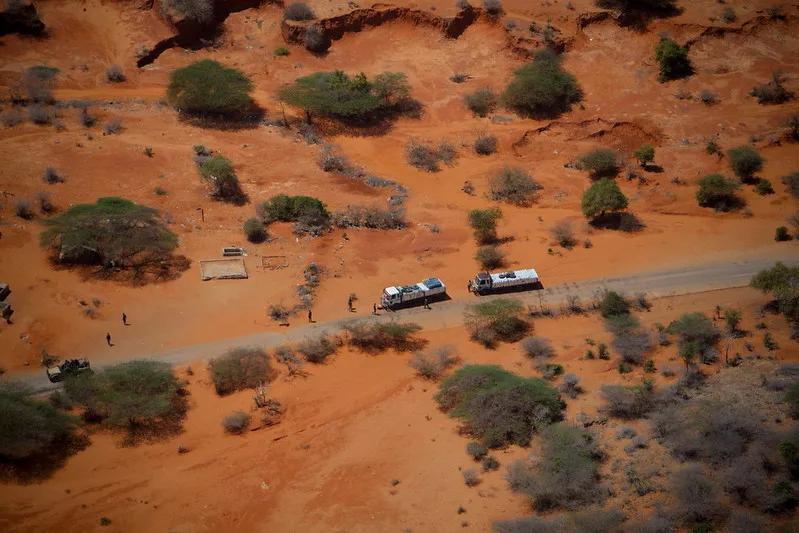
 Flickr Creative Commons License/ AMISOM Public Information
 Lead researcher: Peer Schouten
Partner: Danish Institute for International Studies (DIIS) and independent researchers contracted through the XRF
Duration: November 2025 – October 2026
Countries: DRC, Libya, Uganda, Rwanda, Sudan, South Sudan, Yemen, Myanmar, West Africa
TRACE examines how checkpoints in conflict affected borderlands shape – and are shaped by – shifting forms of authority, trade flows and local moral economies. Combining participatory mapping, interviews and commodity chain analysis, the project develops and tests a typology of checkpoint governance across two workstreams: an in-depth case study in eastern Congo and comparative studies in other border regions, including Libya, Yemen, Myanmar, West Africa, Afghanistan and South Sudan. Across these cases, the research highlights three broad insights:
- Checkpoint systems are shaped as much by geopolitics as by local dynamics – including regional rivalries, cross-border state strategies and competition over corridors.
- Authority over checkpoints varies widely – from fragmented, negotiated arrangements to highly centralised and quasi-bureaucratic systems, sometimes with non-state actors outperforming states in coordination and control.
- Checkpoints can be constitutive infrastructure – not merely taxing trade but actively making circulation possible and defining the boundaries between licit and illicit exchange.
Together, these findings push beyond state-centric frameworks and offer a new way of understanding how power operates in conflict-affected economies.
Scholars engaged under this workstream:
- Peer Schouten (Principal Investigator)
- Joshua Craze
- Ibrahim Jalal
- Abubaker Lndi
- David Mansfield
- Ferenc Dávid Markó
- Xu Peng
- Olivier Walther
For more information regarding this research, contact [email protected]
Comparative papers
Checkpoints, not territory: rethinking conflict | Peer Schouten
This policy brief challenges conventional understandings of conflict by showing that control over circulation – rather than territory – lies at the centre of many contemporary wars. Drawing on comparative research across Yemen, Afghanistan, the Democratic Republic of Congo and Great Lakes, South Sudan, Myanmar, and West Africa, it argues that checkpoints offer a critical but underexplored lens on conflict dynamics. In doing so, the brief highlights how these systems of control shape power, governance and everyday life, and sets out important implications for policy and programming.
Wars over checkpoints | TRACE researchers
This working paper is a collective effort taking stock of discussions during the TRACE workshop held in Entebbe, Uganda, from 19-21 November 2025. The paper unpacks the political and economic logic of checkpoints as central institutions of circulation. Drawing on comparative insights from DR Congo, Libya, Myanmar, South Sudan, Afghanistan, West Africa and Yemen, the paper advances nine theses that challenge conventional readings of roadblocks and reframe them as generative nodes of governance.
Roadblock Geographies: A Typology of Extraction, Circulation, and Authority in Conflict | Peer Schouten
This journal article develops a typology of roadblock geographies in conflict-affected borderlands as extractive landscapes. Drawing on transport geography, it identifies how infrastructural variation—footpaths, roads and ports—shapes who extracts rents, how and to what effect. Rather than viewing roadblocks as mere obstructions, the article frames them as central to the reconfiguration of authority and value along contemporary commodity chains.
Case studies
The TRACE working papers are designed not only as stand-alone contributions, but as building blocks for a broader comparative argument. Taken together, the research moves beyond describing checkpoint practices to explaining how checkpoint regimes emerge, evolve and reshape political and economic order. The following papers illustrate this collective effort, bringing together country-based studies led by individual authors whose work grounds the wider comparative insights.
- Nigeria, Cameroon | Olivier Walther
- Myanmar, Thailand, China | Xu Peng
- Libya, Sudan, Chad | Abubaker Lndi
- Yemen | Ibrahim Jalal
- Afghanistan | David Mansfield
- South Sudan | Joshua Craze and Ferenc Dávid Markó
- Democratic Republic of the Congo and the Great Lakes | Peer Schouten (forthcoming)
Webinar
On 18 June 2026, XCEPT hosted a briefing on how checkpoint economies shape conflict dynamics, governance, humanitarian access, and livelihoods across fragile and conflict-affected settings. Watch the recording of the briefing below.