


Summary
- The Axis of Resistance has proven exceptionally resilient because it represents a new kind of dispersed power that is a distinct feature of a highly interconnected world—a type of challenge that will shape the twenty-first century.
- Over the past twenty-five years, both the Axis and international commerce have been rewired from hub-and-spoke networks with identifiable choke points into complex, adaptive ecosystems with no clear points of failure.
- This report uses a unique research strategy, combining historical survey, deep field research, open-source investigations, and data analysis to describe and explain these twin transformations in unprecedented detail.
- It also presents an innovative analytical framework, called the “capability ladder,” that can enable researchers to identify when Axis members are at risk of evolving into powerful nonstate actors like the Houthis and Hezbollah.
The below shares the overview and the conclusion from the report. To read the full report, download it from this page or access it via the The Century Foundation’s website, where the report was first published.
Overview: Hubs, Spokes, and Worldwide Webs
In February 2026, the United States and Israel launched a war on Iran that they hoped would once and for all break the back of the Islamic Republic and its so-called Axis of Resistance. Operation Epic Fury took long-standing policy assumptions to an extreme: that by hitting the right leaders, weapons facilities, and supply lines, an outside actor could induce catastrophic failure across the Iranian regime and its web of Middle Eastern allies.
But the two powers were using tactics from the age of the telephone exchange against an adversary built for the internet era. Over the past quarter century, two parallel transformations—one in how Iran and its allies build military capability, the other in how the global economy moves goods, money, and information—have rewired both the Axis and international commerce from hub-and-spoke networks with identifiable choke points into complex, adaptive ecosystems with no clear points of failure.
This report uses a unique research strategy, combining historical survey, deep field research, open-source investigations, and data analysis, to describe and explain these twin transformations in unprecedented detail. Its findings help explain why Iran and the Axis have proven so resilient in the face of U.S. and Israeli attempts to crush them: the Axis represents a new kind of dispersed, self-reproducing power—which this report calls an ecosystem—that is a distinct feature of a highly globalized, interconnected world in the midst of a messy power transition to multipolarity. The Axis of Resistance is likely not a one-off but rather a new type of challenge that will shape conflict and politics in the second quarter of the twenty-first century.
The through line is drones, or unmanned aerial vehicles (UAVs). One of the 2026 war’s defining images was of Iran’s screeching Shahed-136 drones plowing into luxury Gulf real estate, critical infrastructure, and American military bases, with billion-dollar U.S. missile defense systems struggling to keep up with an onslaught of these UAVs, which cost a few tens of thousands of dollars to make. The Shahed-136 and earlier Iranian-made one-way attack drones like it tell an important story of how the two transformations have changed the face of modern warfare and blunted the military tactics and policy tools of the late twentieth and early twenty-first centuries. Since the early 2000s, Iran’s Islamic Revolutionary Guards Corps (IRGC) and Hezbollah have developed a model for cultivating and building the capabilities of nonstate allies. Groups are courted, trained, armed, and eventually taught to build their own weapons from commercially available components—most notably, one-way attack drones. Each rung of this “capability ladder” that a group climbs both builds them up and binds them to Iran and one another through shared training, battlefield experience, and knowledge.
At a certain stage—what this report calls a capability tipping point—a small number of these groups cross a threshold. Internal knowledge, networks, and supply-chain access fuse into systems that produce capabilities far beyond those of their insurgent antecedents and make the groups in question much harder to uproot. As more groups have crossed this threshold, the Axis itself has been transformed, from a centrally managed network running through a hub in Tehran, into something more like a self-perpetuating ecosystem.
Power within the ecosystem is unevenly distributed and is constantly shifting. Iran is still its most powerful and consequential node, but the relationship between Tehran and the Axis is one of mutual interdependence. Capabilities, data, and strategic needs flow in multiple directions. As the wars of 2023–26 have shown, the ecosystem can sustain damage to individual nodes and supply routes without collapsing. Even as the Axis came under unprecedented stress, its supply chains rerouted to account for the collapse of the regime of Bashar al-Assad in Syria, and Yemen’s Houthis even expanded into Africa through outreach to a portfolio of different regional actors, enticing potential partners with training on how to use and build UAVs.
The Axis’s transformation would not have been possible without tectonic shifts in the inner workings of the global economy. In the past, state and nonstate groups relied on either powerful state patrons or arms dealers to source Western technology in limited volumes. Now, they can buy almost unlimited amounts of engines for the Shahed-136, for example, directly from Chinese manufacturers. “Smuggling” no longer adequately captures the process by which these goods are transported to their end-users. Illicit and dual-use items intermingle with licit global trade and move through commercial channels too dense and fast-moving to meaningfully police. When one route is disrupted, the supply chain reroutes to another, more or less automatically.
At the same time, new technologies and surging global trade volumes have made it easier to evade Western scrutiny and sanctions. Most of the goods Iran and the Axis need can now be sourced in Asia rather than the United States or Europe and can be transported to their end-users while avoiding Western regulatory reach. Iran and its allies have become proficient at masking the contents and locations of ships and containers, and at setting up, shutting down, and re-forming shell companies faster than Western law enforcement agencies can identify them. The outgrowth of transshipment hubs whose economic models prioritize ease of doing business over sanctions enforcement has helped, too.
The report unpacks these transformations in four parts. It begins with a short introduction to the Axis and Iran’s drone program, then details the capability ladder that Axis groups climb, the global supply-chain shifts that make the model durable, and the expansion of the ecosystem beyond the Axis’s assumed ideological and geographic bounds.
The report argues that policy responses to the proliferation of UAV technology, and to the densely interconnected groups of actors like the Axis who are among its most avid adopters, must be rewired for an age of ecosystems. This means moving away from the critical-node domino theory that defined Operation Epic Fury and toward an approach that maps ecosystems rather than their constituent parts, matches responses to group capabilities, and uses multilateral action to make it harder for armed actors everywhere to build weapons from off-the-shelf components.
Such adaptations will necessitate an honest debate about the limits of what policy can do and the price that states are willing to pay to achieve their objectives. It may be possible to prevent some groups from moving too far up the capability ladder and to constrain some Axis groups. But doing so may involve providing political space for politically unsavory groups; building armed counter-networks that are likely to take on lives of their own; or finding ways to pressure repressive states to improve political and economic conditions in marginalized areas.
The report is the capstone for “Beyond the Axis,” a Century International project supported by the Cross-Border Conflict Evidence, Policy and Trends (XCEPT) research program, funded by UK International Development. Its claims are substantiated by two years of fieldwork, open-source investigations, and data analysis by a multidisciplinary research team. It draws on more than 250 key-informant interviews with officials, Axis group members, businesspeople, and analysts across the Middle East and the Horn of Africa. The report also makes use of purpose-built databases of arms interdictions, drone proliferation, sanctions, and training events; vessel-tracking using automatic identification system (AIS) data and satellite imagery; and hundreds of documentary sources in English, Arabic, Farsi, and Hebrew. This approach allows the researchers to overcome the limits to access that are an inherent challenge to the study of closed regimes and clandestine groups, and to triangulate evidence for key claims. Unless explicitly stated, all data and visualizations in the report were produced for this project.
Rewired Response: Conclusions and Recommendations
During the Iraq and Afghanistan wars, when more U.S. and allied troops were being killed by roadside bombs than any other threat, the U.S. Army established a new initiative, the Joint Improvised Explosive Device Defeat Organization (JIEDDO), to coordinate the response to the use of IEDs and explosively formed penetrators (EFPs). Washington invested billions of dollars in electronic countermeasures, in live digital monitoring capabilities, and in military operations to disrupt the manufacturing and supply networks behind the IED and EFP systems.
The measures were effective in reducing American casualties. But they were a Band-Aid. “JIEDDO was a pretty efficient system for telling you what had killed your troops two days earlier, but it cost us hundreds of millions and billions of dollars. The way we ended the IED and EFP threat to U.S. forces was by withdrawing from Afghanistan and Iraq,” said a former U.S. Army explosive ordnance disposal specialist who served in the two countries in the mid-to-late 2000s. “Ultimately, there was no military or technical solution to the problem.”
Two decades after the invasion of Iraq, the regional wars of 2023–26 showed the long tail of the lessons the IRGC learned from the EFP program, and the changes the IRGC had wrought across the Axis by implementing them. Training groups to build their own weapons produced a much more resilient asymmetric threat than directly supplying them. And by teaching groups to turn networks into systems, the IRGC inadvertently rewired them into a globally connected ecosystem.
Iran’s adversaries have not learned the same lessons. The United States and Israel, having spent two decades targeting supply choke points using sanctions and other tools of economic coercion, moved on to attack physical choke points in the form of key leaders and arms production and storage sites. In 2025, Washington and Tel Aviv repeatedly declared victory over Hamas, Hezbollah, the Houthis, and Iran. But by May 2026, prominent commentators were declaring a relative Iranian victory over the United States and Israel while noting, with surprise, the speed with which Hezbollah had reconstituted itself over the previous year.
Thinking in Ecosystems
The Axis of Resistance is an ecosystem. It is a dense mesh of interdependent actors that is still expanding and is far more adaptive and resilient than many outsiders recognize. And it has been a source, over the past two decades, of increasingly indiscriminate violence conducted at a growing remove. Charting a new policy course that addresses the Axis’s destabilizing role in the region, and its access to strategic weapons, will be challenging. Most states, and most of the policy bodies that serve them, were built during a period in which states could be treated as the primary unit of policy analysis, with regional or thematic connections overlaid on top and armed groups seen as subunits. Somalia, for example, could be understood as a single unit of analysis that was part of the Horn of Africa, and al-Shabaab as a Somalia counterterrorism problem.
These units of analysis and policymaking were always an oversimplification, providing decision-makers at home with an artificial sense of clarity that allowed for streamlined decision-making processes. Of course, as this report has shown, such oversimplifications obscure much more than they clarify. Hamas, Hezbollah, and the Houthis are not just subunits of Palestinian, Lebanese, or Yemeni political systems; nor can they be reduced to a counterterrorism or “Iran threat network” problem for which there is a simple, codifiable set of relatively low-cost solutions. They are formidably capable and networked actors embedded within their own societies and the global economy.
Policymakers recognize this point in the abstract, but struggle at times to know where to start in building a new analytical or policy approach to the problem set. In an earlier XCEPT-supported study, researchers at Chatham House discussed the challenge of conflict resolution in contexts where armed actors are plugged into decentralized, nonhierarchical ecosystems in which institutions, armed groups, and businesses operate across state borders. “If stabilization and peacebuilding in conflict zones are to become more effective,” they wrote, “policymakers must identify key entry points for understanding conflict dynamics . . . [in] a world that increasingly eludes categorization according to nation states or spheres of influence.”
The temptation, when faced with something as complex as the Axis, can be to start too broad—to try to map the entire ecosystem and to be paralyzed by the scale of the task.
The temptation, when faced with something as complex as the Axis, can be to start too broad—to try to map the entire ecosystem and to be paralyzed by the scale of the task. This report is a template for finding a starting point for a workable understanding of and policy response to ecosystemic actors. Rather than building a complete model of the Axis and its relationship with Iran, the authors have taken a single weapon type—Iranian one-way attack UAVs—and used it as an isotope tracer. Drones, as the report has shown, are worth following because they feature at every point in the ecosystem’s expansion, and act as a critical marker of capability breakout. Groups are enticed with the promise of UAV technology, trained in the use of first-person-view drones, then provided with more advanced one-way attack models, and eventually taught to build their own.
Tracing UAV transfers reveals not just a weapons program, but also the shape of the ecosystem that produces it and is produced by it: the model of cultivation, training, and integration; the markers of a group’s progress toward deeper capability and closer ties to Iran; the outgrowth of ecosystems and their integration into larger ecosystems of trade and finance; and, in the case of the Axis, its ongoing expansion into the Horn of Africa.
By taking this approach, the report has produced two sets of implications: a deeper understanding of the mechanics of UAV proliferation; and the tiered policy challenge of dealing with the Axis ecosystem and its expansion.
Going Global: Proliferation and Multilateral Coordination
This report focuses on Iranian UAV proliferation, but its findings carry broader lessons. Iranian drones sit within a wider pattern of proliferation in which more state and nonstate actors are building ever more capable drones, drawing on a commercial component supply that grows and adapts in response to demand. Recent wars in Ukraine, the Middle East, and Africa have accelerated this dynamic, with Iran, Israel, Russia, Ukraine, Turkey, the United States, and the Axis groups (among others) all scaling up production of drones of varying size, range, and sophistication. In the long run, drone proliferation, including of long-range, more strategic variants, will only become more acute. Tried-and-tested policy tools will do little to turn back the tide.
As this report shows, the Axis groups’ current capabilities would have been unthinkable two decades ago, and reaching them required years of IRGC and Hezbollah investment in training and materiel transfers. Iranian and Axis cultivation and training still produce something important—the amalgamation of dense internal networks of skilled people, procurement structures, and embeddedness that gives Axis groups their durability. But today, anyone with an internet connection and a credit card can buy most of the components needed to make weaponized drones and learn how to assemble them through YouTube and other online tutorials.
China’s government has expressly said that it wants to grow its aerospace sector, including providing funding and incentives for the development of long-range UAVs in the same way it did for electric vehicles and solar panels. China’s strategies drove down the cost of production and improved the quality of electric vehicles and solar technology, allowing Chinese exporters to develop a dominant position in the global market. A similar trajectory for the aerospace sector would mean that UAVs and the intermediate components used to make them become more advanced and cheaper in the coming years—not because Iranian firms are copying Western components but because Chinese firms are building and exporting better drones. China, in other words, is fast becoming the world’s UAV choke point. Western officials believe Beijing is aware that Chinese intermediate goods are reaching Iran, Russia, and the Houthis, and that it tolerates this trade. Whether this reflects deliberate strategic calculation or the inertia of a giant export-oriented economy, the net effect is the same.
As for the trade channels that move goods from China to their end-users, these increasingly make use of low-friction transshipment hubs that have, thus far, chosen to prioritize their economic models over U.S. sanctions. The extensive deployment of U.S. sanctions and tariffs over the past two decades has arguably accelerated the development of economic networks, financial channels, shipping infrastructure, and component supply chains now precision-engineered to evade U.S. and Western influence.
For these reasons, the only solution to the democratization of drone technology will be a multilateral one that countries like China, Turkey, and the Emirates believe are in their individual interests. Two developments offer cautious optimism that a conversation, at least, may now be possible in ways that it was previously not. The first is that the costs of UAV proliferation are now visible to states that previously benefited from it or looked the other way. Since February 2026, Iran has directly targeted Saudi Arabia, the Emirates, Bahrain, and Kuwait with drone strikes; it is clear that these countries have direct material interests in restricting UAV proliferation that align, at least partially, with Western policy preferences. The second is that China, perceiving a growing threat to its internal security, has itself begun to take domestic UAV regulation more seriously, clamping down on the use of hobbyist drones around major cities. The industrial drivers making Chinese drones cheaper and more capable are also making them accessible to actors that China has no interest in arming, including criminal organizations and insurgent groups based in China.
Some tentative steps have already been taken toward multilateral action on one case of drone proliferation via commercial channels. In November 2025, the UK government, in its role as the informal UN lead for resolutions on Yemen, introduced new language on dual-use items and materials, while renewing the Security Council’s sanctions regime there. The UK-drafted resolution tasked the UN Panel of Experts that monitors the sanctions regime with reporting on the “direct or indirect sale, supply or transfer” of “dual-use components and precursor chemicals” to Yemen. China and Russia abstained, allowing the resolution to pass. The resolution created space, at a minimum, for multilateral discussion on the role of commercially sourced dual-use components in drone and other forms of modern warfare.
The Axis Ecosystem: A Tiered Approach
Iran and the Axis have proven highly resilient to policies built around the logic of targeting key nodes. They have survived the collapse of the Assad regime, the decimation of Hamas, and significant military damage to Hezbollah and Iran itself. The outcome that the United States and Israel sought in February 2026—precipitating catastrophic failure across the Iranian regime and the Axis—proved out of reach. In fact, the 2026 war showed that achieving these aims would impose a colossal price in blood and treasure: invasion and occupation of Iran (by the United States) and swathes, if not all, of Lebanon (by Israel) while precipitating civil war in Iraq and bombing Yemen into a new humanitarian catastrophe. And even then, if the Iranian regime were to collapse, and Hezbollah were to be defeated militarily, the ecosystem would live on in some form. Most importantly, the capabilities embedded in it would endure, particularly the ability to build and operate long-range drones made from imported parts.
Considering this resilience, what outcomes can policymakers realistically work toward? If eliminating the Axis is not among them, a narrower set of options presents itself from this report’s research: preventing the ecosystem’s further expansion via new groups and constraining the behavior of the groups already within it. Two broad types of policy follow from those two goals: the first targeting pre-breakout groups not yet fully embedded in the ecosystem, and the second dealing with post-breakout groups that have become far more resilient to external measures. These are not the outcomes the authors would ideally want, but they are the ones the report’s evidence suggests are achievable in the near term. This is where the capability ladder is useful as a tool for policymakers. The ladder does not, in and of itself, tell policymakers what to do. What it does is locate a group on the spectrum of capability development and interdependence. It allows policy actors to identify which groups are pre- and post-breakout, and which warrant the most attention. In Africa, al-Shabaab and the Islamist SAF factions warrant the closest attention because they are demonstrably pre-breakout. al-Shabaab would warrant even more attention if it begins using Iranian-designed EFPs or shooting down Predator drones; so too for the SAF if it begins deploying the Safaroog, their Ababil-T variant, in the field. Afar groups and individuals with previous ties to the Houthis could also be monitored for any resumption or deepening of those ties (see Figure 19).
Figure 19
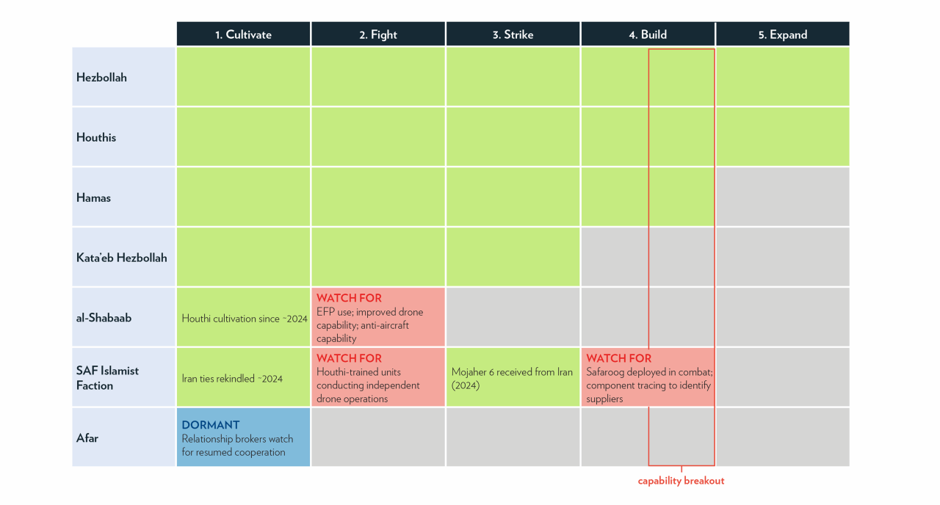
Each group and stage requires its own calibrated response. The rest of this section outlines the tools that policymakers might apply once this determination has been made. All of these policy responses require long-term investment, underscoring another important tension: Western policymakers’ time horizons are often constrained by electoral and budget cycles, and by a constant search for short-term policy “wins” that demonstrate efficacy to voters and political leaders. Such policies, by their nature, are ill-suited to tackling ecosystemic challenges that build slowly before bursting into view.
Before Breakout
For groups that are still being cultivated and trained by Iran or the Axis, there is some potential for intervention. Coercion alone has rarely worked with these groups. What has worked is the possibility of an alternative pathway. In Iraq, groups that Iran had hosted and armed for decades did not, in the end, remain instruments of a purely Iranian agenda. Over time, many developed national political stakes of their own that Tehran could influence, but not direct. But groups that did not build their own constituencies or local agendas—among them, Kata’eb Hezbollah—became more deeply enmeshed in a lopsided, dependent relationship with the IRGC.
The groups the Houthis are now cultivating in Africa can be sorted into two categories. The first, al-Shabaab and the Sudanese Islamist faction within the SAF, are ambitious would-be powers who see Houthi and Iranian support as a pathway to power. The second, the cross-border communities, like the Afar, that the Houthis have targeted, are responsive because they are desperate. The Houthis have been able to map these truly marginal communities because a large number of migrants originate from them and pass through Yemen, fleeing the economic, social and political hardships they face at home in search of a better life in the Gulf states. Afaris and individuals from other marginalized ethnic groups who have responded to Houthi overtures have done so, in turn, because they lack an alternative patron or pathway to improving conditions at home.
The different categories of groups require different policy responses. For ambitious would-be powers like al-Shabaab and the SAF Islamists, the question is one of carrots and sticks: whether pressure can be applied and credible off-ramps offered in a way that pulls them away from Iranian and Houthi support, increased capability and deeper interdependency, without legitimizing their methods or their bids for power at home. This, in turn, requires deep thought about what pressure will work against these groups (both are already subject to U.S. and other sanctions, and al-Shabaab has been targeted by a plethora of military campaigns), who might engage them, and what way out they and their members might be offered when the moment is right. For the marginal cross-border communities the Houthis target, the problem is different and more familiar: governance deficits and economic and political exclusion that make those communities pliable in the first place.
Over the Threshold
Once groups cross the capability tipping point, the costs and risks of attempting to even restrain them increase exponentially. The devastating Israeli offensives on Gaza and Lebanon in 2023–25 are sometimes cited as a demonstration of the potential for outright military defeat. Yet Hezbollah’s partial but unexpected resurgence, and Hamas’s persistence in Gaza, suggest the limits of even maximally violent and legally contested campaigns. Mitigation through sanctions, interdiction, and occasional strikes is a medium-term strategy that this report’s evidence suggests is not, on its own, a solution: it fosters adaptation that makes these policies less effective over time and is likely to produce further rounds of intensive conflict rather than a positive-sum end state.
A more honest reckoning would include options policymakers have so far been reluctant to consider, which carry real moral costs. From the evidence assembled in this report, two stand out—not as the most palatable, but as the most available.
The first is political engagement with at least some post-breakout groups, particularly as they take on governance in the territory they hold. A group administering a population acquires interests in stability, service delivery, and in not being bombed that an insurgent actor does not. This, in turn, provides a degree of leverage under the right circumstances. States have dealt extensively with the Taliban since 2021, and with the new authorities in Damascus since late 2024, accrediting envoys, lifting sanctions, and delisting leaders, often while sidestepping the question of formal recognition. These engagement strategies have produced mixed results: they appear to have moderated the impulses of the Damascus government, but not those of the Taliban in Kabul. Yemen’s Houthis point to the limits of the approach, meanwhile. The group, which is the de facto authority in northwestern Yemen, is engaged in direct talks with Saudi Arabia and with the UN over ending the war in Yemen but has repeatedly sought to use negotiations to engineer a settlement that leaves it in a dominant position in government, something Yemen’s internationally recognized government rejects.
The second option is fostering counterbalancing networks of armed actors, political coalitions, and even businesses, as a hedge against the power of post-breakout groups. But as this report has shown, counter-networks often outlive the moments they were created in. Sponsoring proxies to check other proxies has, in general, a poor track record. It means partnering with morally and legally compromised actors and risks exacerbating the conflicts and cross-border competition that produced the Axis in the first place. Some regional officials and observers believe, for example, that the Emirates has made support for nonstate armed groups in Libya, Sudan, Somalia, and Yemen a pillar of its foreign policy. Emirati officials deny some of these relationships and say that when they do engage with such groups, they do so to protect their national security interests. These observers allege that Emirati backing has only inflamed and prolonged the conflicts in those countries.
Both approaches—engaging with capable actors and building counterbalancing networks—risk accelerating the very drift that Western policymakers say they want to avoid: the slide from a rules-based order.
Western states appear to be in little mood to start building their own networks of allies in the region. Regional officials and observers complain that the United States offers only limited support to state allies like the Lebanese Armed Forces that could counterbalance Axis groups. Washington continues to pressure the Lebanese army to disarm Hezbollah but has offered it little in the way of sustained backing or thought on how to convince the local Shia population that the Lebanese state can and will protect their interests, and Lebanon’s sovereignty, if Hezbollah were to be disbanded.
Both approaches—engaging with capable actors and building counterbalancing networks—risk accelerating the very drift that Western policymakers say they want to avoid: the slide from a rules-based order—albeit a lopsided and often badly mismanaged one—into a transactional free-for-all that amplifies the drivers of conflict rather than containing them. That drift would, in turn, accelerate the trend toward an ecosystemic world order: a swirl of adaptations in a world governed by no single state or institution.
That these are the available choices should be cause for a moment of self-reflection on how much ground the rules-based order has already lost; and the extent to which leaning into the zeitgeist of powerful ecosystems will further erode that order. There is an alternative. States could uphold their own and international laws, rules, and regulations, and press others to do the same, including through multilateral venues such as the UN. Such an idea might seem almost laughably old-fashioned. But in years to come, this moment may look like a missed opportunity—to agree to shared rules not only on drones, but also for the new shapes that war is taking and the preservation of human life.
Conclusion: Beyond the Axis
In a May 2026 commentary for the Atlantic, the neoconservative writer Robert Kagan argued that Iran had achieved “checkmate” in its conflict with the United States. The diagnosis was appealing but misleading. A decade earlier, the scholar and former Department of State official Anne-Marie Slaughter described a world in which the chessboard—in which two sides with fixed pieces line up against one another in the hope of achieving a decisive final move—was being replaced by the web, a world in which networks were as important as raw power. Iran and its Axis of Resistance are just one example of why the old chessboard way of thinking now needs to be set aside.
Two decades of IRGC cultivation, training, and knowledge transfer turned the Axis of Resistance from a hub-and-spoke network of dependent groups into an ecosystem, pushing a small but significant number of Axis groups across a capability tipping point. The ecosystem can still be degraded but cannot, on the evidence of this report, be entirely eliminated. Even if the Iranian regime collapsed, the capabilities embedded across the ecosystem would outlast the Axis itself.
To deal with the Axis, policymakers will have to think beyond the Axis. Find a way in—an isotope tracer—that reveals the ecosystem’s true shape. Sort its members by where they sit on the capability ladder and tier policy responses accordingly. And make it harder, everywhere, for groups to build arms using off-the-shelf components. None of this will eliminate the Axis. It will instead support the more modest work of slowing its expansion, constraining its members, and buying the time in which other things like political settlements, better governance, and multilateral pressure can offer an alternate way forward.
The Axis is not the only ecosystem of its kind. Soon, other ecosystems of armed actors will form, drawing on the same commercial supply chains, the same online knowledge, the same globalized infrastructure. The time to learn its lessons, and adapt, is now.